9E7C | pdb_00009e7c

TRK-fused Gene (TFG) PB1 Domain D60A/D62R Variant


Experimental Data Snapshot

  • Method: X-RAY DIFFRACTION
  • Resolution: 1.91 Å
  • R-Value Free: 
    0.254 (Depositor), 0.262 (DCC) 
  • R-Value Work: 
    0.214 (Depositor), 0.222 (DCC) 
  • R-Value Observed: 
    0.216 (Depositor) 

Starting Model: experimental
View more details

wwPDB Validation   3D Report Full Report


This is version 1.1 of the entry. See complete history


Literature

Multiple roles for TFG ring complexes in neuronal cargo trafficking.

Zhang, Z.Lettman, M.M.Schuh, A.L.Bhattacharyya, B.Randolph, P.Nandakumar, T.Kulkarni, I.Roach, A.Alvin, J.R.Gengler, D.Stagg, S.M.Keck, J.L.Audhya, A.

(2024) bioRxiv 

  • DOI: https://doi.org/10.1101/2024.11.05.621662
  • Primary Citation of Related Structures:  
    9E7C

  • PubMed Abstract: 

    Pathological variants in Trk-fused gene (TFG) have been implicated in a variety of neurodegenerative conditions. In particular, mutations within its amino-terminal PB1 domain have been suggested to cause hereditary spastic paraplegia (HSP), resulting in progressive lower limb spasticity and weakness. The structural basis for this effect is unknown. Here, we combine X-ray crystallography and cryo-electron microscopy to determine a structural model of TFG, demonstrating the mechanism by which it forms octameric ring complexes. A network of electrostatic and hydrophobic interactions defines the interface between protomers. Moreover, we show that mutations identified previously in HSP patients disrupt this interface, destabilizing octamers, which ultimately leads to axonopathy. Surprisingly, the impacts of these variants are not equivalent in vivo, highlighting the existence of multiple, distinct mechanisms by which TFG mutations contribute to neurodegenerative disease.

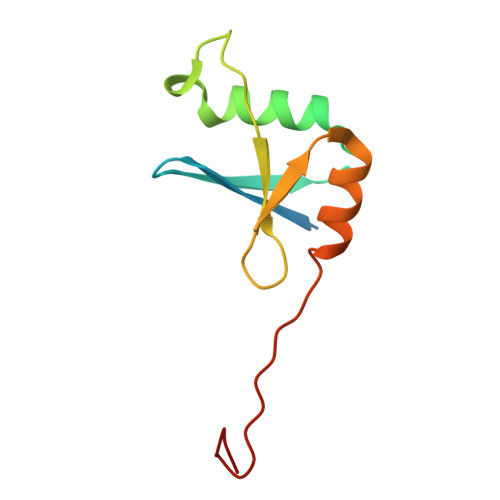
Macromolecules
Find similar proteins by:  (by identity cutoff)  |  3D Structure
Entity ID: 1
MoleculeChains Sequence LengthOrganismDetailsImage
Protein TFG101Homo sapiensMutation(s): 2 
Gene Names: TFG
UniProt & NIH Common Fund Data Resources
Find proteins for Q92734 (Homo sapiens)
Explore Q92734 
Go to UniProtKB:  Q92734
PHAROS:  Q92734
GTEx:  ENSG00000114354 
Entity Groups  
Sequence Clusters30% Identity50% Identity70% Identity90% Identity95% Identity100% Identity
UniProt GroupQ92734
Sequence Annotations
Expand
  • Reference Sequence
Experimental Data & Validation

Experimental Data

  • Method: X-RAY DIFFRACTION
  • Resolution: 1.91 Å
  • R-Value Free:  0.254 (Depositor), 0.262 (DCC) 
  • R-Value Work:  0.214 (Depositor), 0.222 (DCC) 
  • R-Value Observed: 0.216 (Depositor) 
Space Group: C 1 2 1
Unit Cell:
Length ( Å )Angle ( ˚ )
a = 107.018α = 90
b = 32.488β = 104.8
c = 29.246γ = 90
Software Package:
Software NamePurpose
REFMACrefinement
HKL-3000data scaling
HKL-3000data reduction
REFMACphasing

Structure Validation

View Full Validation Report


Entry History & Funding Information

Deposition Data


Funding OrganizationLocationGrant Number
National Institutes of Health/National Institute of General Medical Sciences (NIH/NIGMS)United StatesGM134865
National Institutes of Health/National Institute of Neurological Disorders and Stroke (NIH/NINDS)United StatesNS124165

Revision History  (Full details and data files)

  • Version 1.0: 2024-11-20
    Type: Initial release
  • Version 1.1: 2024-12-04
    Changes: Database references