Download Mendeley
Asynchronous subunit transitions prime acetylcholine receptor activation.
Thompson, M.J., Tessier, C.J.G., Ananchenko, A., Henault, C., Emlaw, J.R., Dehez, F., Zarkadas, E., daCosta, C.J.B., Nury, H., Baenziger, J.E.(2026) Science 391: eadw1264-eadw1264
- PubMed: 41037590 Search on PubMed
- DOI: https://doi.org/10.1126/science.adw1264
- Primary Citation Related Structures:
9E3E, 9E3F, 9E3G - PubMed Abstract:
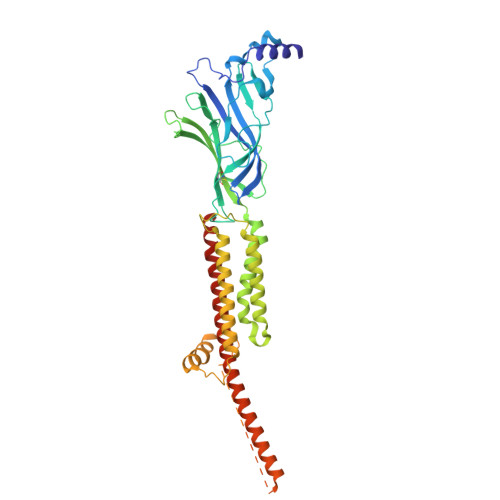
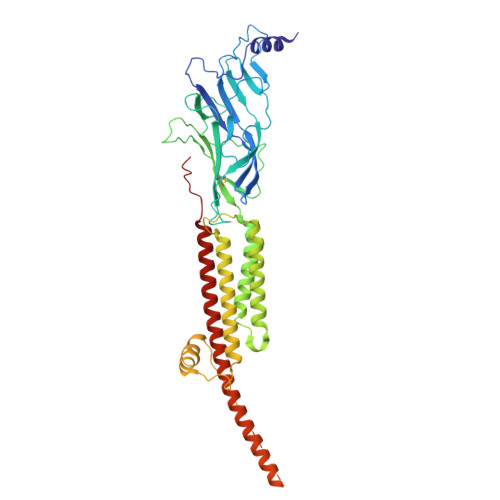
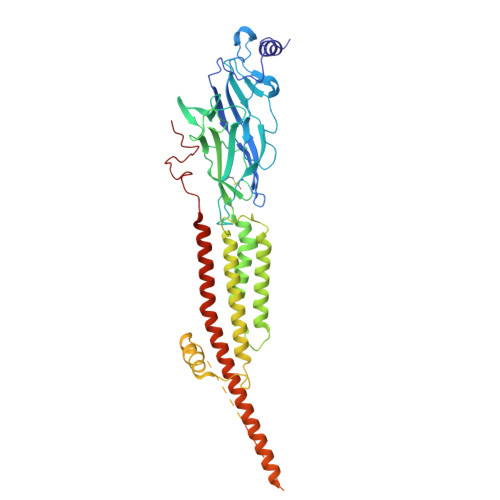
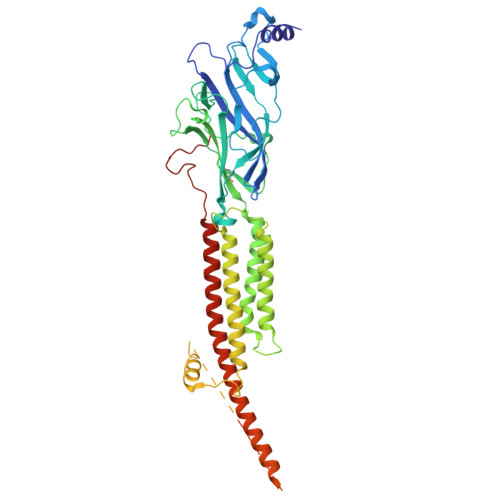
Communication at synapses is facilitated by postsynaptic receptors, which convert a chemical signal into an electrical response. For ligand-gated ion channels, agonist binding triggers rapid transitions through intermediate states leading to a transient open-pore conformation, with these transitions shaping the postsynaptic response. In this work, we determine structures of the muscle-type nicotinic acetylcholine receptor in unliganded, mono-liganded, and di-liganded states. Agonist binding to a single site stabilizes a closed structure where an entire principal agonist-binding subunit transitions to an active-like conformation, whereas the other unoccupied principal subunit remains inactive, albeit poised for activation. Uniting this intermediate structure with single-channel recordings informs a sequential activation mechanism where asynchronous subunit transitions prime the receptor for activation-a finding with implications for an entire superfamily of pentameric ligand-gated ion channels.
- Department of Biochemistry, Microbiology, and Immunology, University of Ottawa, Ottawa, ON, Canada.
Organizational Affiliation: