Download Mendeley
Bottom-up design of Ca 2+ channels from defined selectivity filter geometry.
Liu, Y., Weidle, C., Mihaljevic, L., Watson, J.L., Li, Z., Yu, L.T., Majumder, S., Borst, A.J., Carr, K.D., Kibler, R.D., Gamal El-Din, T.M., Catterall, W.A., Baker, D.(2025) Nature 648: 468-476
- PubMed: 41125887 Search on PubMedSearch on PubMed Central
- DOI: https://doi.org/10.1038/s41586-025-09646-z
- Primary Citation Related Structures:
9DZW, 9E0H - PubMed Abstract:
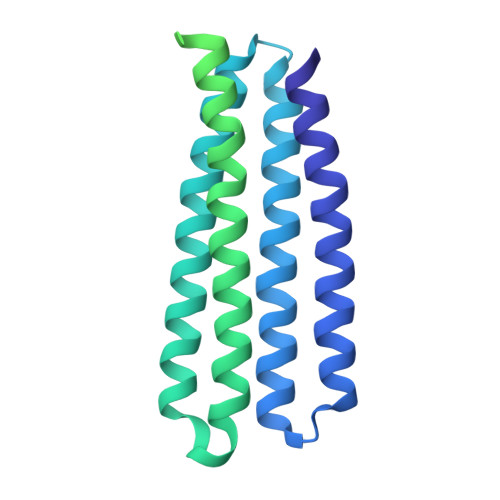
Native ion channels play key roles in biological systems, and engineered versions are widely used as chemogenetic tools and in sensing devices 1,2 . Protein design has been harnessed to generate pore-containing transmembrane proteins, but the design of selectivity filters with precise arrangements of amino acid side chains specific for a target ion, a crucial feature of native ion channels 3 , has been constrained by the lack of methods for placing the metal-coordinating residues with atomic-level precision. Here we describe a bottom-up RFdiffusion-based approach to construct Ca 2+ channels from defined selectivity filter residue geometries, and use this approach to design symmetric oligomeric channels with Ca 2+ selectivity filters having different coordination numbers and different geometries at the entrance of a wider pore buttressed by multiple transmembrane helices. The designed channel proteins assemble into homogeneous pore-containing particles and, for both tetrameric and hexameric ion-coordinating configurations, patch-clamp experiments show that the designed channels have higher conductances for Ca 2+ than for Na + and other divalent ions (Sr 2+ and Mg 2+ ) that are eliminated after mutation of selectivity filter residues. Cryogenic electron microscopy indicates that the design method has high accuracy: the structure of the hexameric Ca 2+ channel is nearly identical to that of the design model. Our bottom-up design approach now enables the testing of hypotheses relating filter geometry to ion selectivity by direct construction, and provides a roadmap for creating selective ion channels for a wide range of applications.
- Department of Biochemistry, University of Washington, Seattle, WA, USA.
Organizational Affiliation: