9DWV | pdb_00009dwv

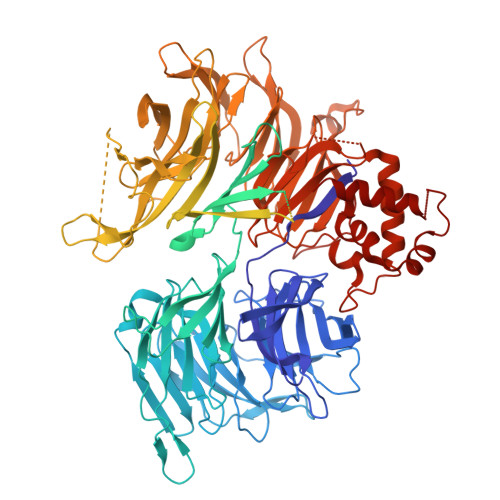
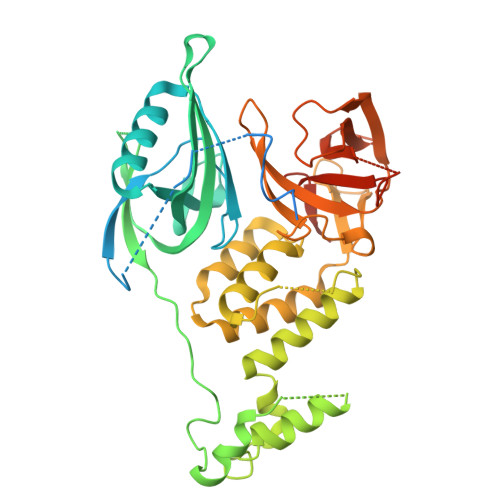
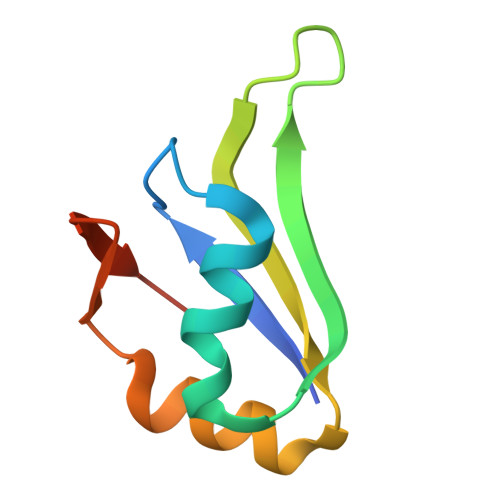
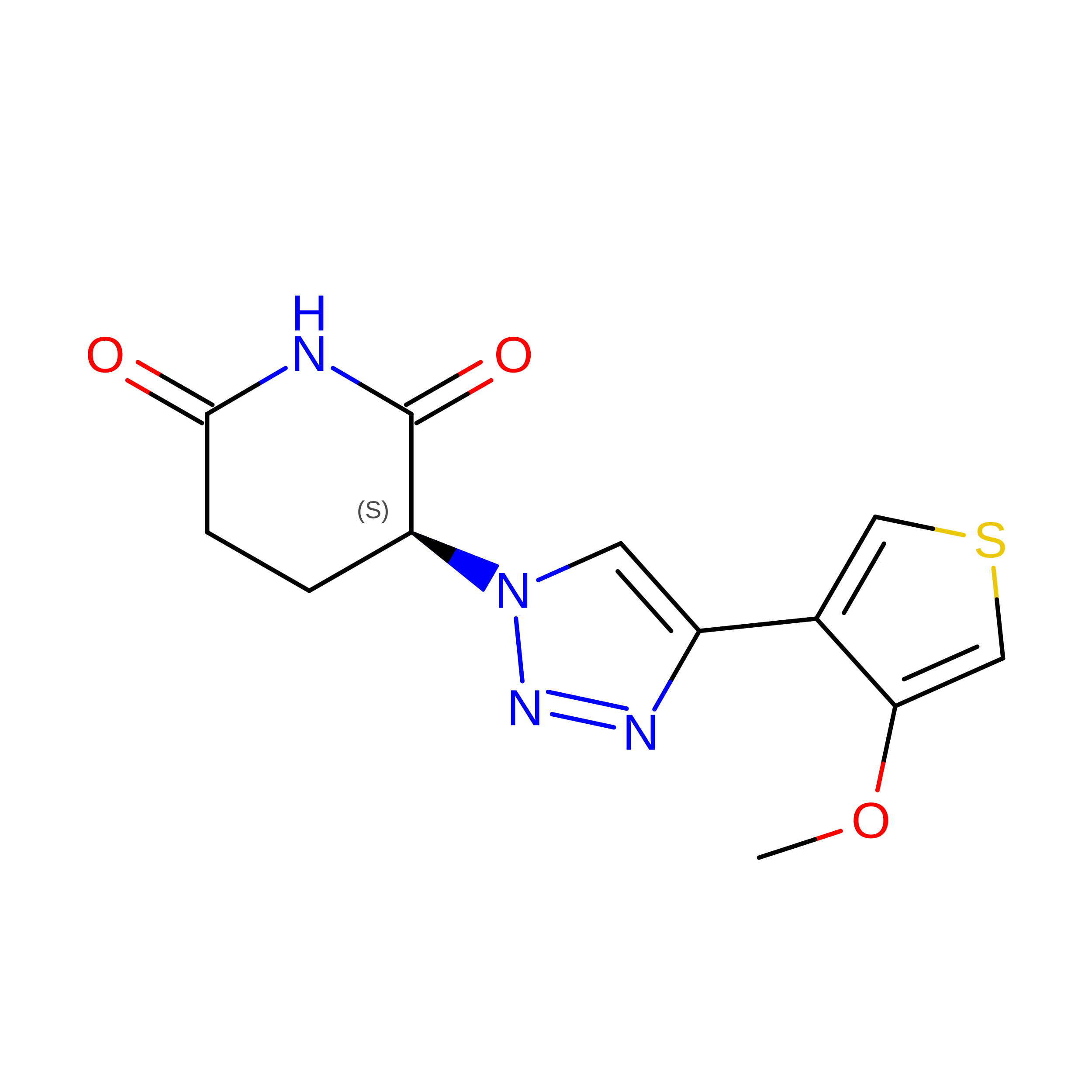
Ternary complex of CRBN-DDB1-PPIL4 RRM domain with FPFT-2216

  • Classification: LIGASE
  • Organism(s): Homo sapiens
  • Expression System: Trichoplusia ni
  • Mutation(s): No 

  • Deposited: 2024-10-10 Released: 2025-08-06 
  • Deposition Author(s): Baek, K., Fischer, E.S.
  • Funding Organization(s): National Institutes of Health/National Cancer Institute (NIH/NCI), Damon Runyon Cancer Research Foundation

Experimental Data Snapshot

  • Method: ELECTRON MICROSCOPY
  • Resolution: 3.50 Å
  • Aggregation State: PARTICLE 
  • Reconstruction Method: SINGLE PARTICLE 

wwPDB Validation   3D Report Full Report


This is version 1.0 of the entry. See complete history


Literature

Unveiling the hidden interactome of CRBN molecular glues.

Baek, K.Metivier, R.J.Roy Burman, S.S.Bushman, J.W.Yoon, H.Lumpkin, R.J.Ryan, J.K.Abeja, D.M.Lakshminarayan, M.Yue, H.Ojeda, S.Xiong, Y.Che, J.Verano, A.L.Schmoker, A.M.Gray, N.S.Donovan, K.A.Fischer, E.S.

(2025) Nat Commun 16: 6831-6831

  • DOI: https://doi.org/10.1038/s41467-025-62099-w
  • Primary Citation of Related Structures:  
    9DWV, 9DWW

  • PubMed Abstract: 

    Induced proximity by molecular glues refers to strategies that leverage the recruitment of proteins to facilitate their modification, regulation or degradation. As prospective design of molecular glues remains challenging, unbiased discovery methods are necessary to discover new chemical targets. Here we establish a high throughput affinity proteomics workflow leveraging E3 ligase activity-impaired CRBN-DDB1ΔB in cell lysates for the unbiased identification of molecular glue targets. By mapping the interaction landscape of CRBN-binding molecular glues, we unveil 298 protein targets and demonstrate the utility of enrichment methods for identifying targets overlooked by established methods. We use a computational workflow to estimate target confidence and perform biochemical and structural validation of uncharacterized neo-substrates. We further identify a lead compound for the previously untargeted non-zinc finger PPIL4 through a biochemical screen. Our study provides a comprehensive inventory of targets chemically recruited to CRBN and delivers a robust and scalable workflow for identifying drug-induced protein interactions in cell lysates.


  • Organizational Affiliation
    • Department of Cancer Biology, Dana-Farber Cancer Institute, Boston, Massachusetts, USA.

Macromolecules
Find similar proteins by:  (by identity cutoff)  |  3D Structure
Entity ID: 1
MoleculeChains Sequence LengthOrganismDetailsImage
DNA damage-binding protein 11,140Homo sapiensMutation(s): 0 
Gene Names: DDB1XAP1
UniProt & NIH Common Fund Data Resources
Find proteins for Q16531 (Homo sapiens)
Explore Q16531 
Go to UniProtKB:  Q16531
PHAROS:  Q16531
GTEx:  ENSG00000167986 
Entity Groups  
Sequence Clusters30% Identity50% Identity70% Identity90% Identity95% Identity100% Identity
UniProt GroupQ16531
Sequence Annotations
Expand
  • Reference Sequence
Find similar proteins by:  (by identity cutoff)  |  3D Structure
Entity ID: 2
MoleculeChains Sequence LengthOrganismDetailsImage
Protein cereblon444Homo sapiensMutation(s): 0 
Gene Names: CRBNAD-006
UniProt & NIH Common Fund Data Resources
Find proteins for Q96SW2 (Homo sapiens)
Explore Q96SW2 
Go to UniProtKB:  Q96SW2
PHAROS:  Q96SW2
GTEx:  ENSG00000113851 
Entity Groups  
Sequence Clusters30% Identity50% Identity70% Identity90% Identity95% Identity100% Identity
UniProt GroupQ96SW2
Sequence Annotations
Expand
  • Reference Sequence
Find similar proteins by:  (by identity cutoff)  |  3D Structure
Entity ID: 3
MoleculeChains Sequence LengthOrganismDetailsImage
Peptidyl-prolyl cis-trans isomerase-like 482Homo sapiensMutation(s): 0 
Gene Names: PPIL4
EC: 5.2.1.8
UniProt & NIH Common Fund Data Resources
Find proteins for Q8WUA2 (Homo sapiens)
Explore Q8WUA2 
Go to UniProtKB:  Q8WUA2
PHAROS:  Q8WUA2
GTEx:  ENSG00000131013 
Entity Groups  
Sequence Clusters30% Identity50% Identity70% Identity90% Identity95% Identity100% Identity
UniProt GroupQ8WUA2
Sequence Annotations
Expand
  • Reference Sequence
Small Molecules
Experimental Data & Validation

Experimental Data

  • Method: ELECTRON MICROSCOPY
  • Resolution: 3.50 Å
  • Aggregation State: PARTICLE 
  • Reconstruction Method: SINGLE PARTICLE 
EM Software:
TaskSoftware PackageVersion
MODEL REFINEMENTPHENIX

Structure Validation

View Full Validation Report


Entry History & Funding Information

Deposition Data


Funding OrganizationLocationGrant Number
National Institutes of Health/National Cancer Institute (NIH/NCI)United StatesR01CA214608
Damon Runyon Cancer Research FoundationUnited StatesDRG-2514-24

Revision History  (Full details and data files)

  • Version 1.0: 2025-08-06
    Type: Initial release