9DWN | pdb_00009dwn

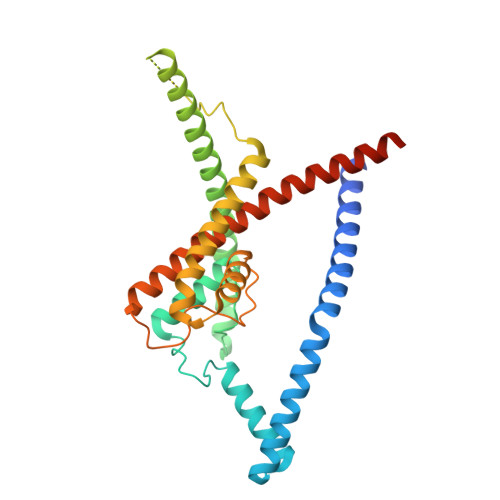
hTHIK1 Cryo-EM structure in GDN detergent


Experimental Data Snapshot

  • Method: ELECTRON MICROSCOPY
  • Resolution: 3.20 Å
  • Aggregation State: PARTICLE 
  • Reconstruction Method: SINGLE PARTICLE 

wwPDB Validation   3D Report Full Report


This is version 1.1 of the entry. See complete history


Literature

The cryo-EM structure and physical basis for anesthetic inhibition of the THIK1 K2P channel.

Riel, E.B.Bu, W.Joseph, T.T.Khajoueinejad, L.Eckenhoff, R.G.Riegelhaupt, P.M.

(2025) Proc Natl Acad Sci U S A 122: e2421654122-e2421654122

  • DOI: https://doi.org/10.1073/pnas.2421654122
  • Primary Citation of Related Structures:  
    9DWN

  • PubMed Abstract: 

    THIK1 tandem pore domain (K2P) potassium channels regulate microglial surveillance of the central nervous system and responsiveness to inflammatory insults. With microglia recognized as critical to the pathogenesis of neurodegenerative diseases, THIK1 channels are putative therapeutic targets to control microglia dysfunction. While THIK channels can principally be distinguished from other K2Ps by their distinctive inhibitory response to volatile anesthetics (VAs), molecular details governing THIK channel gating remain largely unexplored. Here, we report a 3.2 Å cryo-electron microscopy structure of the THIK1 channel in a closed conformation. A central pore gate located directly below the THIK1 selectivity filter is formed by inward-facing TM4 helix tyrosine residues that occlude the ion conduction pathway. VA inhibition of THIK requires closure of this central pore gate. Using a combination of anesthetic photolabeling, electrophysiology, and molecular dynamics simulation, we identify a functionally critical THIK1 VA binding site positioned between the central gate and a structured section of the THIK1 TM2/TM3 loop. Our results demonstrate the molecular architecture of the THIK1 channel and elucidate critical structural features involved in regulation of THIK1 channel gating and anesthetic inhibition.


  • Organizational Affiliation
    • Department of Anesthesiology, Weill Cornell Medical College, New York, NY 10065.

Macromolecules
Find similar proteins by:  (by identity cutoff)  |  3D Structure
Entity ID: 1
MoleculeChains Sequence LengthOrganismDetailsImage
Potassium channel subfamily K member 13
A, B
309Homo sapiensMutation(s): 0 
Gene Names: KCNK13
Membrane Entity: Yes 
UniProt & NIH Common Fund Data Resources
Find proteins for Q9HB14 (Homo sapiens)
Explore Q9HB14 
Go to UniProtKB:  Q9HB14
GTEx:  ENSG00000152315 
Entity Groups  
Sequence Clusters30% Identity50% Identity70% Identity90% Identity95% Identity100% Identity
UniProt GroupQ9HB14
Glycosylation
Glycosylation Sites: 2Go to GlyGen: Q9HB14-1
Sequence Annotations
Expand
  • Reference Sequence
Small Molecules
Ligands 2 Unique
IDChains Name / Formula / InChI Key2D Diagram3D Interactions
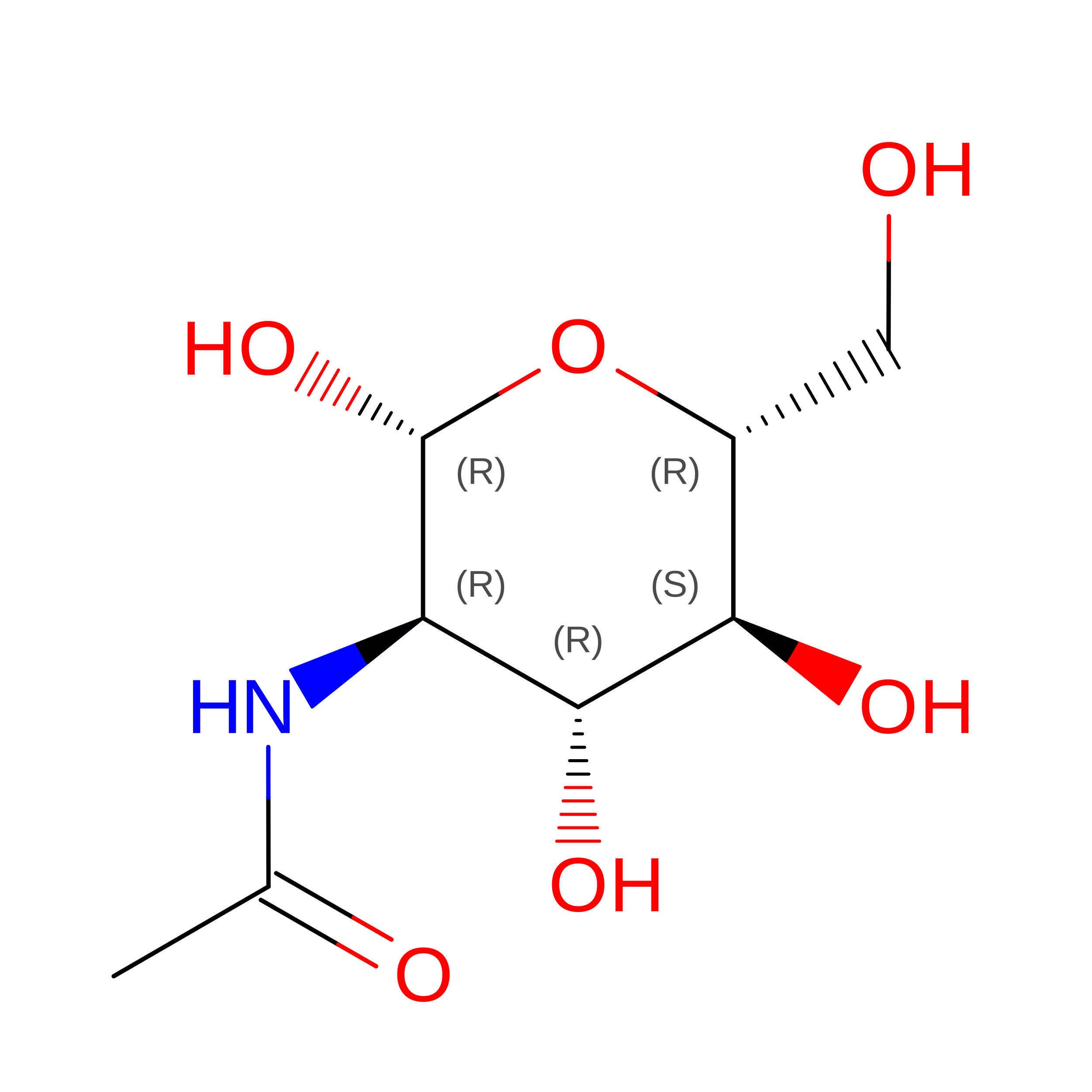
NAG (Subject of Investigation/LOI)
Query on NAG

Download Ideal Coordinates CCD File 
C [auth A],
D [auth A],
G [auth B],
H [auth B]
2-acetamido-2-deoxy-beta-D-glucopyranose
C8 H15 N O6
OVRNDRQMDRJTHS-FMDGEEDCSA-N
K (Subject of Investigation/LOI)
Query on K

Download Ideal Coordinates CCD File 
E [auth A],
F [auth A],
I [auth B],
J [auth B],
K [auth B]
POTASSIUM ION
K
NPYPAHLBTDXSSS-UHFFFAOYSA-N
Experimental Data & Validation

Experimental Data

  • Method: ELECTRON MICROSCOPY
  • Resolution: 3.20 Å
  • Aggregation State: PARTICLE 
  • Reconstruction Method: SINGLE PARTICLE 
EM Software:
TaskSoftware PackageVersion
MODEL REFINEMENTPHENIX

Structure Validation

View Full Validation Report


Entry History & Funding Information

Deposition Data


Funding OrganizationLocationGrant Number
National Institutes of Health/National Institute of General Medical Sciences (NIH/NIGMS)United StatesR01 GM145918
National Institutes of Health/National Institute of General Medical Sciences (NIH/NIGMS)United StatesK08-GM132781

Revision History  (Full details and data files)

  • Version 1.0: 2025-04-16
    Type: Initial release
  • Version 1.1: 2025-05-28
    Changes: Data collection