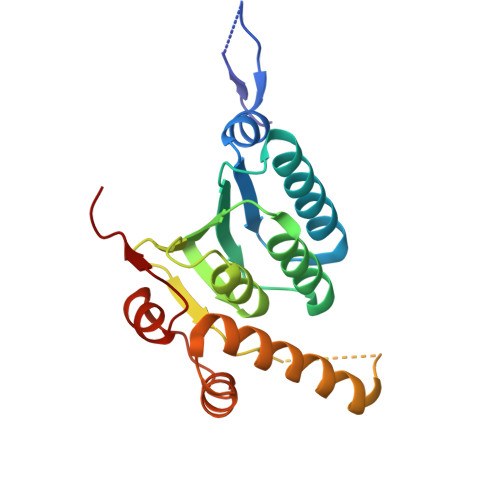
9DW0 | pdb_00009dw0

Human ClpX-bound ClpP

  • Classification: STRUCTURAL PROTEIN
  • Organism(s): Homo sapiens
  • Expression System: Escherichia coli 0.1197
  • Mutation(s): No 

  • Deposited: 2024-10-08 Released: 2025-10-15 
  • Deposition Author(s): Chen, W.C.
  • Funding Organization(s): National Science Foundation (NSF, United States), National Institutes of Health/National Institute of General Medical Sciences (NIH/NIGMS), National Institutes of Health/National Institute of Neurological Disorders and Stroke (NIH/NINDS)

Experimental Data Snapshot

  • Method: ELECTRON MICROSCOPY
  • Resolution: 2.80 Å
  • Aggregation State: PARTICLE 
  • Reconstruction Method: SINGLE PARTICLE 

Starting Model: in silico
View more details

wwPDB Validation   3D Report Full Report


This is version 1.2 of the entry. See complete history


Literature

Cryo-EM structures of human ClpXP reveal mechanisms of assembly and proteolytic activation.

Chen, W.Lander, G.C.Yang, J.

(2026) Nat Commun 17: 1064-1064

  • DOI: https://doi.org/10.1038/s41467-025-67010-1
  • Primary Citation of Related Structures:  
    9DW0, 9DW1, 9DW3, 9P9V, 9PB1, 9YKX, 9YKZ

  • PubMed Abstract: 

    The human ClpXP complex (hClpXP) orchestrates mitochondrial protein quality control through targeted degradation of misfolded and unnecessary proteins. While bacterial ClpXP systems are well characterized, the assembly and regulation of human ClpXP remain poorly understood. In this study, we elucidate the complete assembly pathway of hClpXP through high-resolution cryo-electron microscopy (cryo-EM) structures. Our findings confirm that hClpP exists as a single-ring heptamer in isolation and reveal a previously undocumented initial assembly complex in which hexameric hClpX first engages with heptameric hClpP. We further demonstrate how this interaction drives substantial conformational rearrangements that facilitate the formation of tetradecameric hClpP within the fully assembled complex. Notably, we characterize a unique eukaryotic sequence in hClpX, termed the E-loop, which plays a critical role in stabilizing hexamer assembly and maintaining ATPase activity. Additionally, we show that peptide binding at the hClpP active site triggers further structural changes essential for achieving full proteolytic competence. Together, these structures provide unprecedented mechanistic insights into the stepwise assembly and activation of hClpXP, significantly advancing our understanding of this essential mitochondrial protein degradation machinery.


  • Organizational Affiliation
    • Department of Integrative Structural and Computational Biology, Scripps Research, La Jolla, CA, USA.

Macromolecules
Find similar proteins by:  (by identity cutoff)  |  3D Structure
Entity ID: 1
MoleculeChains Sequence LengthOrganismDetailsImage
ATP-dependent Clp protease proteolytic subunit, mitochondrial192Homo sapiensMutation(s): 0 
Gene Names: CLPP
EC: 3.4.21.92
UniProt & NIH Common Fund Data Resources
Find proteins for Q16740 (Homo sapiens)
Explore Q16740 
Go to UniProtKB:  Q16740
PHAROS:  Q16740
GTEx:  ENSG00000125656 
Entity Groups  
Sequence Clusters30% Identity50% Identity70% Identity90% Identity95% Identity100% Identity
UniProt GroupQ16740
Sequence Annotations
Expand
  • Reference Sequence
Experimental Data & Validation

Experimental Data

  • Method: ELECTRON MICROSCOPY
  • Resolution: 2.80 Å
  • Aggregation State: PARTICLE 
  • Reconstruction Method: SINGLE PARTICLE 
EM Software:
TaskSoftware PackageVersion
RECONSTRUCTIONcryoSPARC4.3
MODEL REFINEMENTPHENIX1.21_5207

Structure Validation

View Full Validation Report


Entry History & Funding Information

Deposition Data

  • Released Date: 2025-10-15 
  • Deposition Author(s): Chen, W.C.

Funding OrganizationLocationGrant Number
National Science Foundation (NSF, United States)United States--
National Institutes of Health/National Institute of General Medical Sciences (NIH/NIGMS)United StatesS10OD032467
National Institutes of Health/National Institute of Neurological Disorders and Stroke (NIH/NINDS)United StatesNS095892

Revision History  (Full details and data files)

  • Version 1.0: 2025-10-15
    Type: Initial release
  • Version 1.1: 2026-03-04
    Changes: Data collection, Database references
  • Version 1.2: 2026-03-11
    Changes: Data collection, Database references