Download Mendeley
HURP facilitates spindle assembly by stabilizing microtubules and working synergistically with TPX2.
Valdez, V.A., Ma, M., Gouveia, B., Zhang, R., Petry, S.(2024) Nat Commun 15: 9689-9689
- PubMed: 39516491 Search on PubMedSearch on PubMed Central
- DOI: https://doi.org/10.1038/s41467-024-53630-6
- Primary Citation Related Structures:
9DUQ - PubMed Abstract:
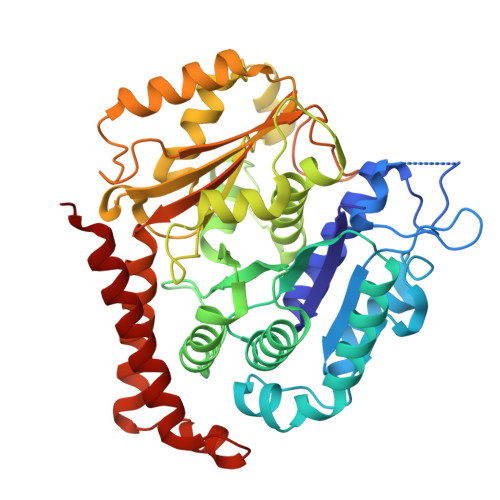
In vertebrate spindles, most microtubules are formed via branching microtubule nucleation, whereby microtubules nucleate along the side of pre-existing microtubules. Hepatoma up-regulated protein (HURP) is a microtubule-associated protein that has been implicated in spindle assembly, but its mode of action is yet to be defined. In this study, we show that HURP is necessary for RanGTP-induced branching microtubule nucleation in Xenopus egg extract. Specifically, HURP stabilizes the microtubule lattice to promote microtubule formation from γ-TuRC. This function is shifted to promote branching microtubule nucleation through enhanced localization to TPX2 condensates, which form the core of the branch site on microtubules. Lastly, we provide a high-resolution cryo-EM structure of HURP on the microtubule, revealing how HURP binding stabilizes the microtubule lattice. We propose a model in which HURP stabilizes microtubules during their formation, and TPX2 preferentially enriches HURP to microtubules to promote branching microtubule nucleation and thus spindle assembly.
- Department of Molecular Biology, Princeton University, Princeton, NJ, USA.
Organizational Affiliation: