Download Mendeley
A Post-translational Histidine-Histidine Cross-Link Enhances Enzymatic Oxygen Reduction Activity with Greater pH Adaptability.
Liu, Y., Vilbert, A.C., Ghosh, B., Young, R.P., Merkley, E.D., Mukherjee, A., Phan, L., Van Stappen, C., Baghi-Damodaran, A., Miner, K.D., Adkins, J., Cort, J., Lu, Y.(2025) J Am Chem Soc 147: 37688-37700
- PubMed: 41047894 Search on PubMed
- DOI: https://doi.org/10.1021/jacs.5c12710
- Primary Citation Related Structures:
9DTH, 9DTI - PubMed Abstract:
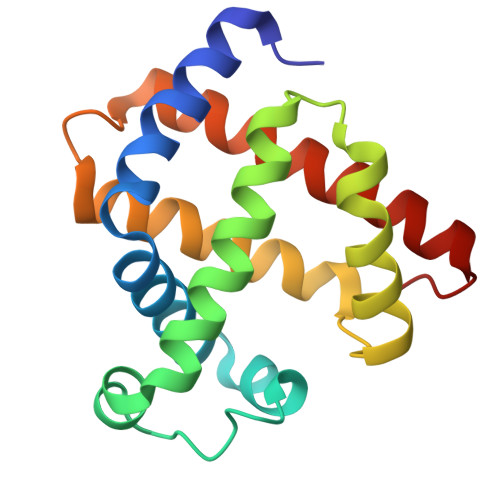
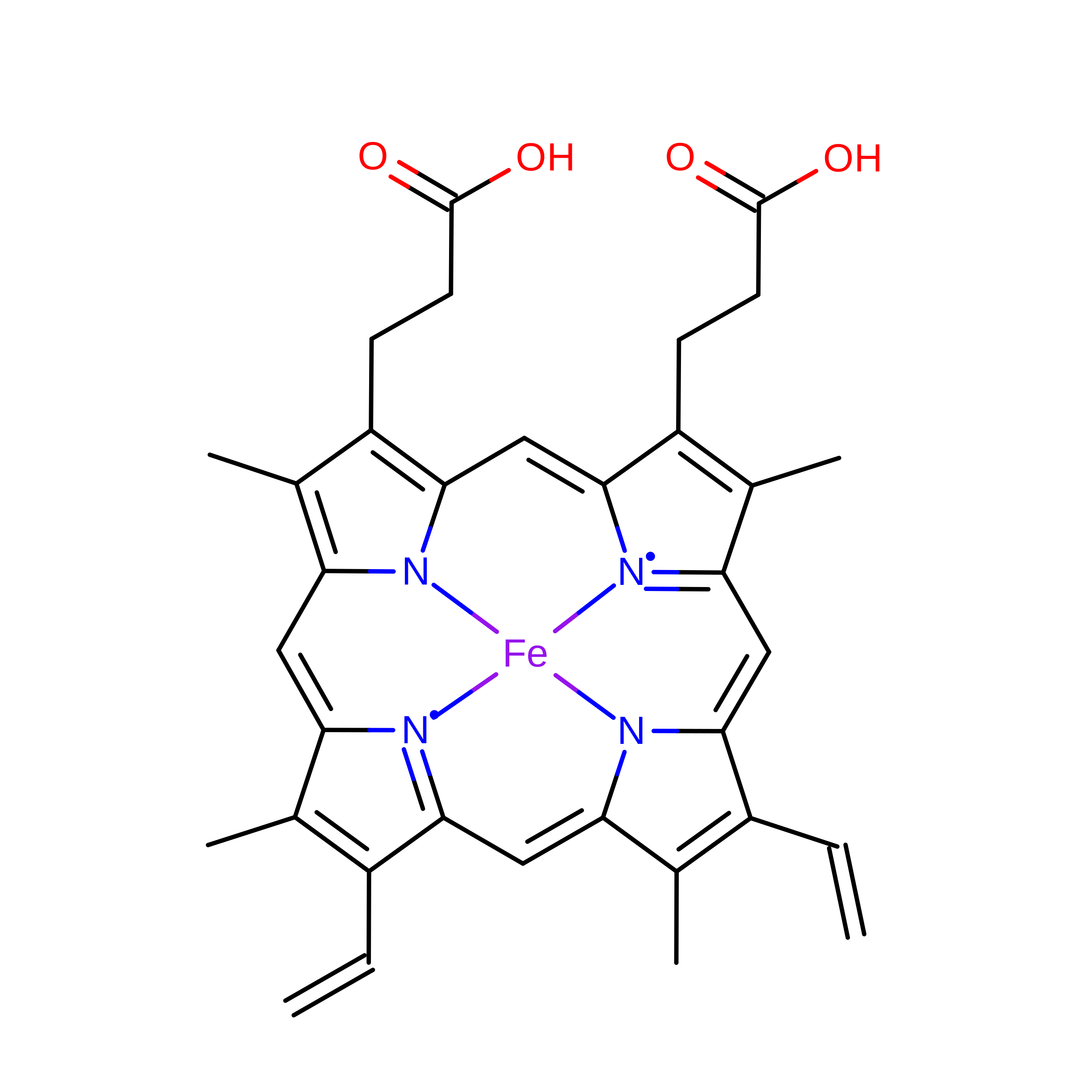
Cross-linked protein residues exist as enzyme cofactors to enable or enhance catalytic activities. Despite their importance in nature, the chemical identity of the cross-links is limited to certain amino acid combinations, whose function and the formation mechanism remain insufficiently understood due to the difficulty in isolating native enzymes without the cross-links. Herein, we report the formation and characterization of both His-Tyr and His-His cross-links under oxidative enzymatic turnover conditions in L29H/F33Y/F43H Mb, a structural and functional model of heme-copper oxidase (HCO). The connectivity of the cross-link was characterized as N ε2 (His29)-C δ2 (His43) by mass spectrometry (LC-MS/MS) and nuclear magnetic resonance (NMR). Interestingly, formation of the cross-link significantly enhances the oxygen reduction activity of the enzyme at neutral or basic pH with higher product specificity. X-ray crystallography has identified a novel Tyr-His cross-link through a Tyr-O-His linkage. Our mechanistic studies indicate the involvement of high-valent heme-iron and the neighboring tyrosine in an oxidative self-processing pathway to generate the cross-link. This work serves as a new example while providing insights into the enzyme cross-link formation, allowing the design of artificial biocatalysts containing these novel cross-links with higher activity and pH adaptability.
- Department of Chemistry, University of Texas at Austin, Austin, Texas 78712, United States.
Organizational Affiliation: