Download Mendeley
Design and evolution of the tetracycline repressor into sulfonylurea herbicide-responsive gene switches for field crops.
McBride, K.E., Kakani, N.K., Bozhanova, N.G., Fang, J., Lowe, K., Leija, C., McGonigle, B., Schreiter, E.R., Hermanson, F., Chan, M., Arling, M., Wang, N., Cho, H.J., Richey, C., Hoerster, G., Marvin, J.S., Lenderts, B., McReynolds, M.R., Hastings, C., Madrigal, A., Falco, S.C., Lassner, M.W., Anand, A., Gordon-Kamm, W., Looger, L.L.(2026) Nat Commun 17
- PubMed: 42259793 Search on PubMedSearch on PubMed Central
- DOI: https://doi.org/10.1038/s41467-026-73848-w
- Primary Citation Related Structures:
9DT2, 9DT3, 9DT4, 9DT5 - PubMed Abstract:
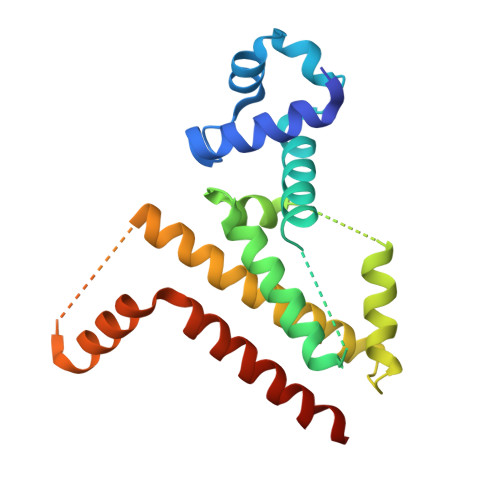
Chemically inducible expression systems enable transgene expression regulation in response to external small molecules. Tetracycline repressor (TetR)-based gene switches work in plants, but antibiotics are neither approved nor advisable for crop use. Here we report engineering of TetR mutants that respond to approved sulfonylurea (SU) herbicides instead of antibiotics. Designed variants show low-nanomolar EC 50 values for ethametsulfuron-methyl (Es) or chlorsulfuron and tightly bind the Tet operator sequence, but only in the absence of corresponding SUs. Crystal structures of two repressors in complex with their respective SU ligands reveal extensive interactions explaining their strong binding. The Es repressor-based gene switch is introduced into tobacco, soybean, maize, rice, and Arabidopsis, and robust reporter gene activation is observed upon herbicide application. Addition of a repressor-regulated siRNA targeting the repressor transcript increases the magnitude and spatial distribution of the response following herbicide treatment and results in a partially bistable gene switch. The SU repressors also function well in mammalian cell culture and may enable regulation of additional genes in conjunction with TetR.
- Research and Development, Corteva Agriscience, Johnston, IA, USA. kmcswitch@gmail.com.
Organizational Affiliation: