Download Mendeley
Energy filtering enables macromolecular MicroED data at sub-atomic resolution.
Clabbers, M.T.B., Hattne, J., Martynowycz, M.W., Gonen, T.(2025) Nat Commun 16: 2247-2247
- PubMed: 40050283 Search on PubMedSearch on PubMed Central
- DOI: https://doi.org/10.1038/s41467-025-57425-1
- Primary Citation Related Structures:
9DHO - PubMed Abstract:
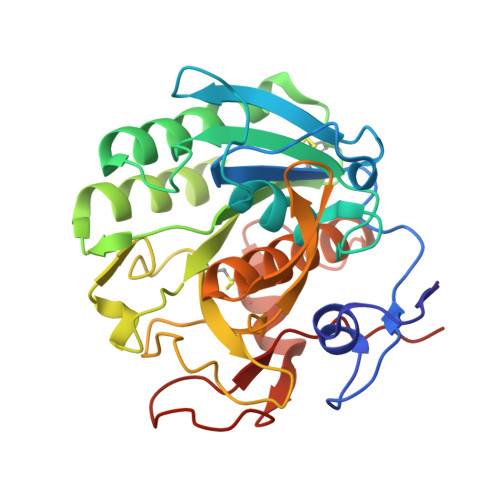
High-resolution information is important for accurate structure modeling but is challenging to attain in macromolecular crystallography due to the rapid fading of diffracted intensities at increasing resolution. While direct electron detection essentially eliminates the read-out noise during MicroED data collection, other sources of noise remain and limit the measurement of faint high-resolution reflections. Inelastic scattering significantly contributes to noise, raising background levels and broadening diffraction peaks. We demonstrate a substantial improvement in signal-to-noise ratio by using energy filtering to remove inelastically scattered electrons. This strategy results in sub-atomic resolution MicroED data from proteinase K crystals, enabling the visualization of detailed structural features. Interestingly, reducing the noise further reveals diffuse scattering that may hold additional structural information. Our findings suggest that combining energy filtering and direct detection provides more accurate measurements at higher resolution, facilitating precise model refinement and improved insights into protein structure and function.
- Howard Hughes Medical Institute, University of California, Los Angeles, CA, 90095, USA.
Organizational Affiliation: