Download Mendeley
Cryo-EM Structure of Recombinantly Expressed hUGDH Unveils a Hidden, Alternative Allosteric Inhibitor.
O'Brien, J.H., Kadirvelraj, R., Tseng, P.S., Ross-Kemppinen, N., Crich, D., Walsh Jr., R.M., Wood, Z.A.(2025) Biochemistry 64: 92-104
- PubMed: 39680853 Search on PubMedSearch on PubMed Central
- DOI: https://doi.org/10.1021/acs.biochem.4c00555
- Primary Citation Related Structures:
9DGZ, 9DH0 - PubMed Abstract:
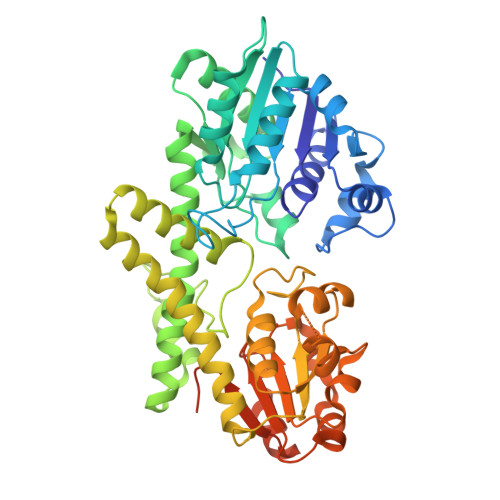
Human UDP-glucose dehydrogenase (hUGDH) catalyzes the oxidation of UDP-glucose into UDP-glucuronic acid, an essential substrate in the Phase II metabolism of drugs. hUGDH is a hexamer that exists in an equilibrium between an active (E) state and an inactive (E Ω ) state, with the latter being stabilized by the binding of the allosteric inhibitor UDP-xylose (UDP-Xyl). The allosteric transition between E Ω and E is slow and can be observed as a lag in progress curves. Previous analysis of the lag suggested that unliganded hUGDH exists mainly as E Ω , but two unique crystal forms suggest that the enzyme favors the E state. Resolving this discrepancy is necessary to fully understand the allosteric mechanism of hUGDH. Here, we used cryo-EM to show that recombinant hUGDH expressed in Escherichia coli copurifies with UDP-4-keto-xylose (UX4O), which mimics the UDP-Xyl inhibitor and favors the E Ω state. Cryo-EM studies show that removing UX4O from hUGDH shifts the ensemble to favor the E state. This shift is consistent with progress curve analysis, which shows the absence of a lag for unliganded hUGDH. Inhibition studies show that hUGDH has similar affinities for UDP-Xyl and UX4O. The discovery that UX4O inhibits allosteric hUGDH suggests that UX4O may be the physiologically relevant inhibitor of allosteric UGDHs in bacteria that do not make UDP-Xyl.
- Department of Biochemistry & Molecular Biology, University of Georgia, Athens, Georgia 30602, United States.
Organizational Affiliation: