9DGM | pdb_00009dgm

T-junction triangle 8-11

  • Classification: DNA
  • Organism(s): synthetic construct
  • Mutation(s): No 

  • Deposited: 2024-09-02 Released: 2025-11-12 
  • Deposition Author(s): Koomullam, N., Mao, C.
  • Funding Organization(s): National Science Foundation (NSF, United States)

Experimental Data Snapshot

  • Method: X-RAY DIFFRACTION
  • Resolution: 6.63 Å
  • R-Value Free: 
    0.230 (Depositor), 0.232 (DCC) 
  • R-Value Work: 
    0.173 (Depositor), 0.172 (DCC) 
  • R-Value Observed: 
    0.179 (Depositor) 

Starting Model: in silico
View more details

wwPDB Validation   3D Report Full Report


This is version 1.1 of the entry. See complete history


Literature

Crystallographic Study of DNA T-Junction via Crystal Engineering.

Li, X.Siraj, N.Sha, R.Mao, C.

(2025) Angew Chem Int Ed Engl 64: e18174-e18174

  • DOI: https://doi.org/10.1002/anie.202518174
  • Primary Citation of Related Structures:  
    9DFY, 9DFZ, 9DG0, 9DGL, 9DGM, 9DGN

  • PubMed Abstract: 

    Engineering DNA crystals is the primary motivation for structural DNA nanotechnology. Among many potential applications, such crystals promise as a platform to precisely (in terms of both location and orientation) organize biomolecules into 3D crystals for X-ray crystallographic studies of the guest biomolecules. The crystal formation depends on rationally designed DNA frameworks instead of unpredictable interactions between the guest molecule themselves; thus, avoiding the crystallization problem of biomolecules. This approach was proposed 40 years ago, however, has not been realized so far. Herein, we report an effort along this direction to study DNA T-junction, a common DNA structure used in DNA nanoconstruction. This study is an initial demonstration of the feasibility of the 40-year-old proposal. We expect that it would be quickly adapted to study many other molecules, particularly nucleic acids (e.g., aptamers, catalytic DNAs/RNAs, ribozymes, and ribonucleoproteins) that are, otherwise, difficult to be studied.


  • Organizational Affiliation
    • Purdue University, Department of Chemistry, West Lafayette, IN, 47907, USA.

Macromolecules

Find similar nucleic acids by:  Sequence   |   3D Structure  

Entity ID: 1
MoleculeChains LengthOrganismImage
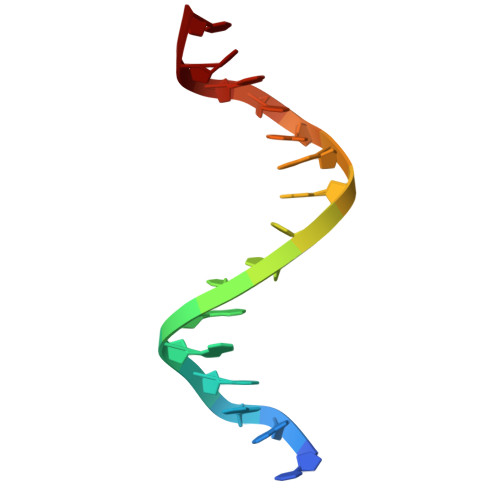
DNA (5'-D(*CP*AP*GP*CP*AP*GP*CP*CP*TP*GP*AP*AP*TP*AP*CP*T)-3')16synthetic construct
Sequence Annotations
Expand
  • Reference Sequence

Find similar nucleic acids by:  Sequence   |   3D Structure  

Entity ID: 2
MoleculeChains LengthOrganismImage
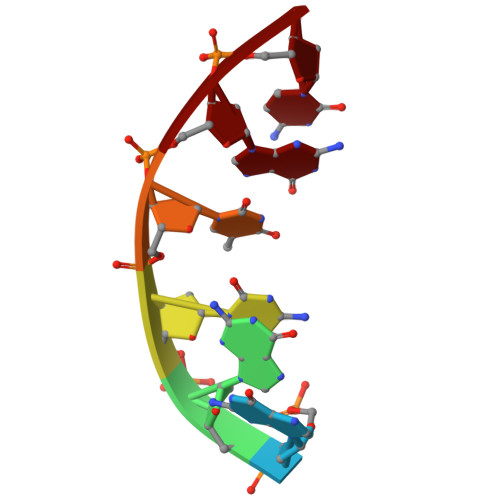
DNA (5'-D(P*GP*GP*CP*TP*GP*C)-3')6synthetic construct
Sequence Annotations
Expand
  • Reference Sequence
Find similar nucleic acids by:  (by identity cutoff)  |  3D Structure
Entity ID: 3
MoleculeChains LengthOrganismImage
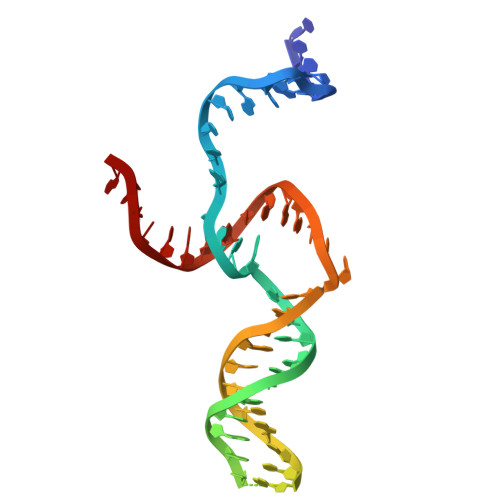
DNA (58-MER)58synthetic construct
Sequence Annotations
Expand
  • Reference Sequence

Find similar nucleic acids by:  Sequence   |   3D Structure  

Entity ID: 4
MoleculeChains LengthOrganismImage
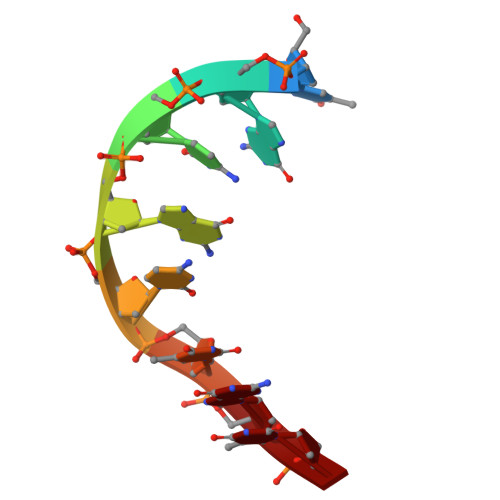
DNA (5'-D(*TP*GP*CP*GP*CP*TP*GP*T)-3')D [auth E]8synthetic construct
Sequence Annotations
Expand
  • Reference Sequence
Experimental Data & Validation

Experimental Data

  • Method: X-RAY DIFFRACTION
  • Resolution: 6.63 Å
  • R-Value Free:  0.230 (Depositor), 0.232 (DCC) 
  • R-Value Work:  0.173 (Depositor), 0.172 (DCC) 
  • R-Value Observed: 0.179 (Depositor) 
Space Group: H 3
Unit Cell:
Length ( Å )Angle ( ˚ )
a = 167.49α = 90
b = 167.49β = 90
c = 78.099γ = 120
Software Package:
Software NamePurpose
PHENIXrefinement
HKL-2000data reduction
HKL-2000data scaling
PHASERphasing

Structure Validation

View Full Validation Report


Entry History & Funding Information

Deposition Data


Funding OrganizationLocationGrant Number
National Science Foundation (NSF, United States)United StatesCCF 2107393

Revision History  (Full details and data files)

  • Version 1.0: 2025-11-12
    Type: Initial release
  • Version 1.1: 2025-12-24
    Changes: Database references