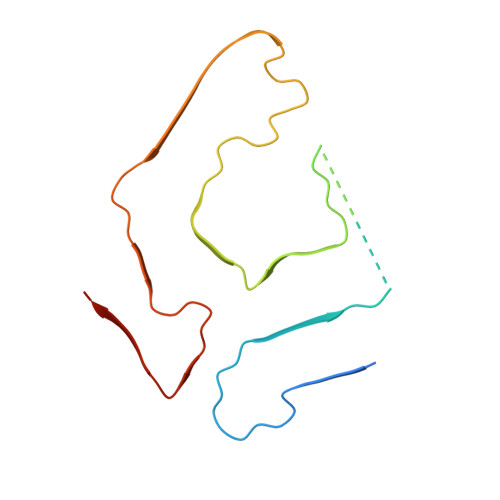
9D27 | pdb_00009d27

Cryo-EM structure of amyloid fibril extracted from kidney of a variant ATTR T60A amyloidosis patient 3

  • Classification: PROTEIN FIBRIL
  • Organism(s): Homo sapiens
  • Mutation(s): Yes 

  • Deposited: 2024-08-08 Released: 2025-08-13 
  • Deposition Author(s): Nguyen, A.B., Fernandez-Ramirez, M.C., Saelices, L.
  • Funding Organization(s): National Institutes of Health/Eunice Kennedy Shriver National Institute of Child Health & Human Development (NIH/NICHD), American Heart Association

Experimental Data Snapshot

  • Method: ELECTRON MICROSCOPY
  • Resolution: 3.19 Å
  • Aggregation State: HELICAL ARRAY 
  • Reconstruction Method: HELICAL 

Starting Model: experimental
View more details

wwPDB Validation   3D Report Full Report


This is version 1.3 of the entry. See complete history


Literature

Structural and molecular homogeneity of ATTRv-T60A amyloid fibrils across patients and organs.

Fernandez-Ramirez, M.D.C.Nguyen, B.A.Afrin, S.Singh, V.Evers, B.Shelton, J.M.Escobar, C.L.Bassett, P.Wang, L.Pekala, M.Ahmed, Y.Cabrera Hernandez, L.O.Pedretti, R.Singh, P.Canepa, J.Wosztyl, A.Li, Y.Boyer, D.R.Cao, Q.Saelices, L.

(2025) Structure 33: 2013-2019.e4

  • DOI: https://doi.org/10.1016/j.str.2025.09.008
  • Primary Citation of Related Structures:  
    9D21, 9D23, 9D24, 9D27, 9D2G

  • PubMed Abstract: 

    Transthyretin amyloidosis is a systemic protein misfolding disorder with diverse clinical phenotypes, including cardiomyopathy, polyneuropathy, or a combination of both. While structural polymorphism of amyloid fibrils has been linked to disease heterogeneity in neurodegenerative disorders, its role in transthyretin amyloidosis remains unclear. Here, we used cryo-electron microscopy to analyze ex vivo fibrils extracted from the hearts of three patients carrying the T60A mutation, a variant associated with mixed cardiac and neuropathic symptoms. In one patient, we additionally examined fibrils from the thyroid, kidney, and liver. All fibrils across patients and tissues adopted a single morphology previously associated with cardiomyopathy. Complementary molecular analyses revealed high compositional homogeneity. Notably, we extracted fibrils from the liver, an organ considered fibril-free, with seeding capacity in vitro. These findings suggest structural homogeneity as a hallmark of cardiac and mixed phenotypes, and provide a mechanistic rationale for the transmission of amyloidosis following domino liver transplantation.


  • Organizational Affiliation
    • Center for Alzheimer's and Neurodegenerative Diseases, Department of Biophysics, Peter O'Donnell Jr. Brain Institute, University of Texas Southwestern Medical Center (UTSW), Dallas, TX, USA.

Macromolecules
Find similar proteins by:  (by identity cutoff)  |  3D Structure
Entity ID: 1
MoleculeChains Sequence LengthOrganismDetailsImage
Transthyretin
A, B, C, D, E
127Homo sapiensMutation(s): 1 
UniProt & NIH Common Fund Data Resources
Find proteins for P02766 (Homo sapiens)
Explore P02766 
Go to UniProtKB:  P02766
PHAROS:  P02766
GTEx:  ENSG00000118271 
Entity Groups  
Sequence Clusters30% Identity50% Identity70% Identity90% Identity95% Identity100% Identity
UniProt GroupP02766
Sequence Annotations
Expand
  • Reference Sequence
Experimental Data & Validation

Experimental Data

  • Method: ELECTRON MICROSCOPY
  • Resolution: 3.19 Å
  • Aggregation State: HELICAL ARRAY 
  • Reconstruction Method: HELICAL 
EM Software:
TaskSoftware PackageVersion
RECONSTRUCTIONRELION4.0
MODEL REFINEMENTPHENIX1.20

Structure Validation

View Full Validation Report


Entry History & Funding Information

Deposition Data


Funding OrganizationLocationGrant Number
National Institutes of Health/Eunice Kennedy Shriver National Institute of Child Health & Human Development (NIH/NICHD)United States1DP2HL163810-01
American Heart AssociationUnited States847236

Revision History  (Full details and data files)

  • Version 1.0: 2025-08-13
    Type: Initial release
  • Version 1.1: 2025-10-22
    Changes: Data collection, Database references
  • Version 1.2: 2025-10-29
    Changes: Data collection, Database references
  • Version 1.3: 2025-12-17
    Changes: Data collection, Database references