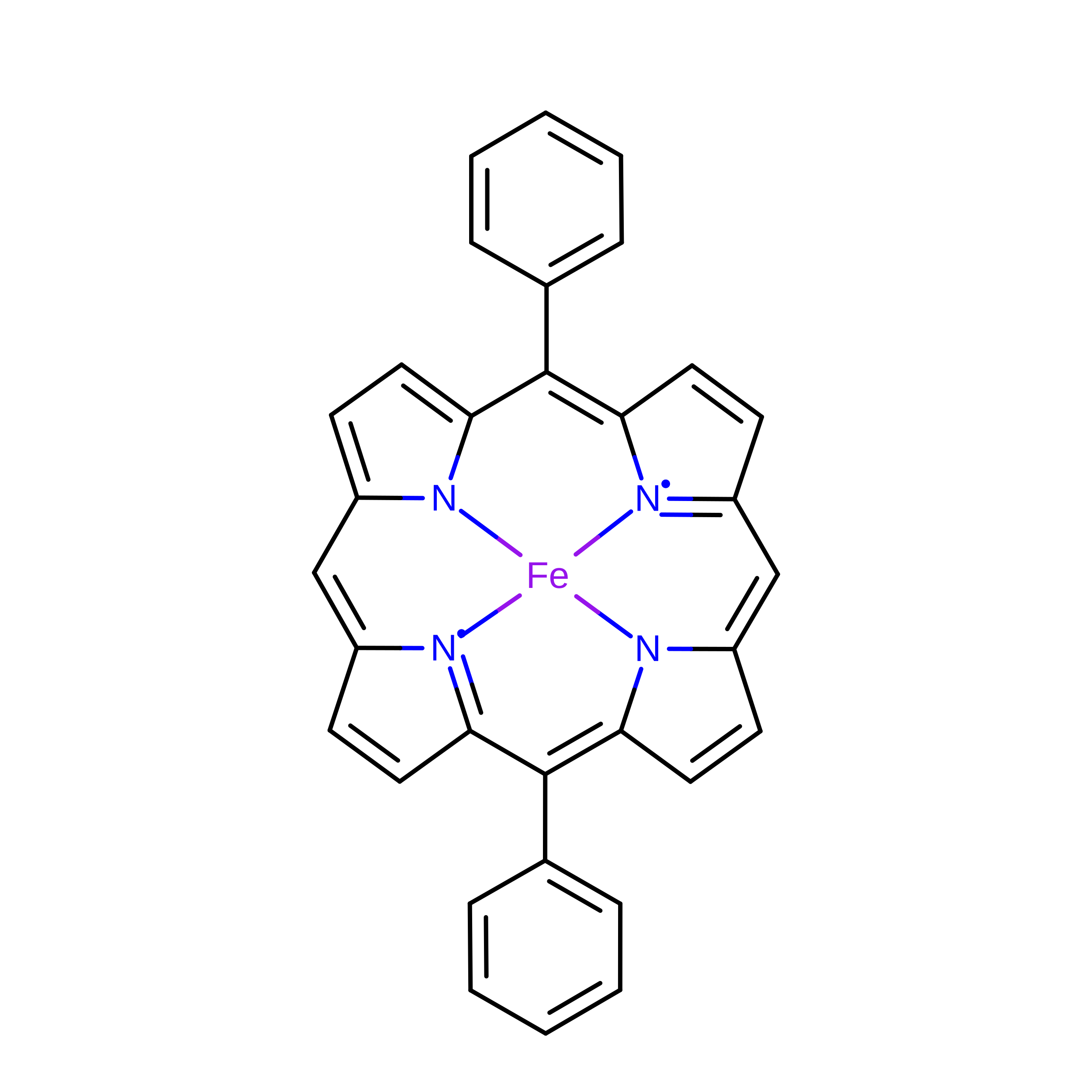
9CTE | pdb_00009cte

De novo design of protein catalysts for new-to-nature reactions

  • Classification: DE NOVO PROTEIN
  • Organism(s): synthetic construct
  • Expression System: Escherichia coli
  • Mutation(s): No 

  • Deposited: 2024-07-25 Released: 2025-05-07 
  • Deposition Author(s): Hou, K., DeGrado, W.F.
  • Funding Organization(s): National Science Foundation (NSF, United States), National Institutes of Health/National Institute of General Medical Sciences (NIH/NIGMS)

Experimental Data Snapshot

  • Method: X-RAY DIFFRACTION
  • Resolution: 2.26 Å
  • R-Value Free: 
    0.278 (Depositor), 0.277 (DCC) 
  • R-Value Work: 
    0.232 (Depositor), 0.231 (DCC) 
  • R-Value Observed: 
    0.236 (Depositor) 

Starting Model: in silico
View more details

wwPDB Validation 3D Report Full Report

Validation slider image for 9CTE

Ligand Structure Quality Assessment 


This is version 1.1 of the entry. See complete history

Literature

De novo design of porphyrin-containing proteins as efficient and stereoselective catalysts.

Hou, K.Huang, W.Qi, M.Tugwell, T.H.Alturaifi, T.M.Chen, Y.Zhang, X.Lu, L.Mann, S.I.Liu, P.Yang, Y.DeGrado, W.F.

(2025) Science 388: 665-670

  • DOI: https://doi.org/10.1126/science.adt7268
  • Primary Citation Related Structures: 
    9CTE

  • PubMed Abstract: 

    De novo design of protein catalysts with high efficiency and stereoselectivity provides an attractive approach toward the design of environmentally benign catalysts. Here, we design proteins that incorporate histidine-ligated synthetic porphyrin and heme ligands. Four of 10 designed proteins catalyzed cyclopropanation with an enantiomeric ratio greater than 99:1. A second class of proteins were designed to catalyze a silicon-hydrogen insertion and were optimized by directed evolution in whole cells. The evolved proteins incorporated features unlikely to be generated by computational design alone, including a proline in an α helix. Molecular dynamics simulations showed that as the proteins evolved toward higher activity, their conformational ensembles narrowed to favor more productive conformations. Our work demonstrates that efficient de novo protein catalysts are designable and should be useful for manifold chemical processes.


  • Organizational Affiliation
    • Department of Pharmaceutical Chemistry and Cardiovascular Research Institute, University of California, San Francisco, CA, USA.

Macromolecule Content 

  • Total Structure Weight: 15.82 kDa 
  • Atom Count: 958 
  • Modeled Residue Count: 110 
  • Deposited Residue Count: 132 
  • Unique protein chains: 1

Macromolecules

Find similar proteins by:|  3D Structure
Entity ID: 1
MoleculeChains  Sequence LengthOrganismDetailsImage
De novo protein132synthetic constructMutation(s): 0 

Experimental Data & Validation

Experimental Data

  • Method: X-RAY DIFFRACTION
  • Resolution: 2.26 Å
  • R-Value Free:  0.278 (Depositor), 0.277 (DCC) 
  • R-Value Work:  0.232 (Depositor), 0.231 (DCC) 
  • R-Value Observed: 0.236 (Depositor) 
Space Group: I 41 2 2
Unit Cell:
Length ( Å )Angle ( ˚ )
a = 71.273α = 90
b = 71.273β = 90
c = 114.942γ = 90
Software Package:
Software NamePurpose
PHENIXrefinement
XDSdata reduction
Aimlessdata scaling
PHASERphasing

Structure Validation

View Full Validation Report


Ligand Structure Quality Assessment 


Entry History 

& Funding Information

Deposition Data


Funding OrganizationLocationGrant Number
National Science Foundation (NSF, United States)United States--
National Institutes of Health/National Institute of General Medical Sciences (NIH/NIGMS)United States--

Revision History  (Full details and data files)

  • Version 1.0: 2025-05-07
    Type: Initial release
  • Version 1.1: 2025-05-21
    Changes: Database references