Download Mendeley
From sequence to scaffold: Computational design of protein nanoparticle vaccines from AlphaFold2-predicted building blocks.
Haas, C.M., Jasti, N., Dosey, A., Allen, J.D., Gillespie, R., McGowan, J., Leaf, E.M., Crispin, M., DeForest, C.A., Kanekiyo, M., King, N.P.(2025) Proc Natl Acad Sci U S A 122: e2409566122-e2409566122
- PubMed: 41183183 Search on PubMedSearch on PubMed Central
- DOI: https://doi.org/10.1073/pnas.2409566122
- Primary Citation Related Structures:
9CLZ, 9CM0, 9CM1 - PubMed Abstract:
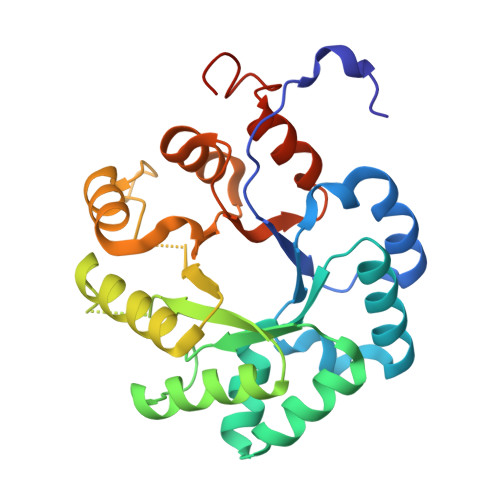
Self-assembling protein nanoparticles are being increasingly utilized in the design of next-generation vaccines due to their ability to induce antibody responses of superior magnitude, breadth, and durability. Computational protein design offers a route to nanoparticle scaffolds with structural and biochemical features tailored to specific vaccine applications. Although strategies for designing self-assembling proteins have been established, the recent development of powerful machine learning (ML)-based tools for protein structure prediction and design provides an opportunity to overcome several of their limitations. Here, we leveraged these tools to develop a generalizable method for designing self-assembling proteins starting from AlphaFold2 predictions of oligomeric protein building blocks. We used the method to generate six 60-subunit protein nanoparticles with icosahedral symmetry, and single-particle cryoelectron microscopy reconstructions of three of them revealed that they were designed with atomic-level accuracy. To transform one of these nanoparticles into a functional immunogen, we reoriented its termini through circular permutation, added a genetically encoded oligomannose-type glycan, and displayed a stabilized trimeric variant of the influenza hemagglutinin receptor-binding domain through a rigid de novo linker. The resultant immunogen elicited potent receptor-blocking and neutralizing antibody responses in mice. Our results demonstrate the practical utility of ML-based protein modeling tools in the design of nanoparticle vaccines. More broadly, by eliminating the requirement for experimentally determined structures of protein building blocks, our method dramatically expands the number of starting points available for designing self-assembling proteins.
- Department of Chemical Engineering, University of Washington, Seattle, WA 98195.
Organizational Affiliation: