Download Mendeley
Large protein-like leader peptides engage differently with RiPP halogenases and lanthionine synthetases.
Vidya, F., Luo, Y., Wu, H., van der Donk, W.A., McShan, A.C., Agarwal, V.(2025) Nat Commun 16: 9273-9273
- PubMed: 41115907 Search on PubMedSearch on PubMed Central
- DOI: https://doi.org/10.1038/s41467-025-64365-3
- Primary Citation Related Structures:
9CJX - PubMed Abstract:
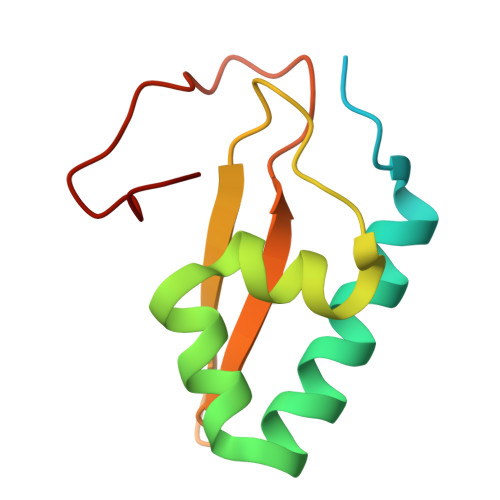
The biosynthesis of ribosomally synthesized and post-translationally modified peptides (RiPPs) involves binding of the N-terminal leader region of precursor peptides to peptide-modifying enzymes and subsequent modification of the C-terminal core. Canonical RiPP leaders are short and unstructured. However, atypical RiPP leaders called nitrile hydratase-like leader peptides (NHLPs) are longer and structured. The sequence and structural divergence dictate that the NHLPs engage with peptide modifying enzymes using binding modes that are distinct from that for the canonical short leader peptides. Here, we investigate the molecular basis of NHLP engagement with class II lanthionine synthetases (LanMs). Using genome mining, we identify a LanM that is selective for the NHLP while modifying diverse core peptides. The solution NMR structure of the NHLP reveals a rigid tertiary fold. Biochemically verified computational models support a bimodal mechanism for NHLP binding to LanMs. Findings developed here illuminate unique protein-protein interaction modalities that guide RiPP biosynthesis.
- School of Chemistry and Biochemistry, Georgia Institute of Technology, Atlanta, GA, USA.
Organizational Affiliation: