Download Mendeley
Structural basis for nuclear import of adeno-associated virus serotype 6 capsid protein.
Hoad, M., Nematollahzadeh, S., Petersen, G.F., Roby, J.A., Alvisi, G., Forwood, J.K.(2025) J Virol 99: e0134524-e0134524
- PubMed: 39692478 Search on PubMedSearch on PubMed Central
- DOI: https://doi.org/10.1128/jvi.01345-24
- Primary Citation Related Structures:
9CFT - PubMed Abstract:
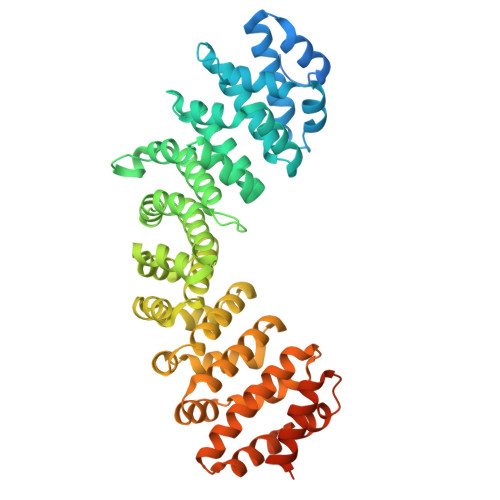
Adeno-associated viruses (AAVs) are the most extensively researched viral vectors for gene therapy globally. The AAV viral protein 1 (VP1) N-terminus controls the capsid's ability to translocate into the cell nucleus; however, the exact mechanism of this process is largely unknown. In this study, we sought to elucidate the precise interactions between AAV serotype 6 (AAV6), a promising vector for immune disorders, and host transport receptors responsible for vector nuclear localization. Focusing on the positively charged basic areas within the N-terminus of AAV6 VP1, we identified a 53-amino acid region that interacts with nuclear import receptors. We measured the binding affinities between this region and various nuclear import receptors, discovering a notably strong interaction with IMPα5 and IMPα7 in the low nanomolar range. We also elucidated the X-ray crystal structure of this region in complex with an importin alpha (IMPα) isoform, uncovering its binding as a bipartite nuclear localization signal (NLS). Furthermore, we show that using this bipartite NLS, AAV6 VP1 capsid protein can localize to the nucleus of mammalian cells in a manner dependent on the IMPα/IMPβ nuclear import pathway. This study provides detailed insights into the interaction between the AAV6 VP1 capsid protein and nuclear import receptors, deepening our knowledge of AAV nuclear import mechanisms and establishing a basis for the improvement of AAV6-based gene therapy vectors.IMPORTANCEAAVs, recognized as the most extensively researched viral vectors for gene therapy globally, offer significant advantages over alternatives due to their small size, non-pathogenic nature, and innate ability for tissue-specific targeting. AAVs are required to localize to the nucleus to perform their role as a gene therapy vector; however, the precise mechanisms that facilitate this process remain unknown. Despite sharing overt genomic similarities with AAV1 and AAV2, AAV6 is a unique serotype. It is currently recognized for its ability to effectively transduce hematopoietic cell lineages and, consequently, is considered promising for the treatment of immune disorders. Identifying the exact mechanisms that permit AAV6 to access the nucleus can open up new avenues for gene therapy vector engineering, which can ultimately lead to increased therapeutic benefits.
- School of Dentistry and Medical Sciences, Charles Sturt University, Wagga Wagga, New South Wales, Australia.
Organizational Affiliation: