Download Mendeley
Molecular Basis of alpha-Glycine C-H Activation by a Nonheme Fe(II)/2-Oxoglutarate Dioxygenase.
Chen, M., Wanniarachchi, T.N., Caranto, J.D., Seabra, G., Bruner, S.D., Ding, Y.(2026) Biochemistry 65: 1726-1736
- PubMed: 42048655 Search on PubMedSearch on PubMed Central
- DOI: https://doi.org/10.1021/acs.biochem.6c00143
- Primary Citation Related Structures:
9C9N, 9CI4, 9PYO, 9PZE - PubMed Abstract:
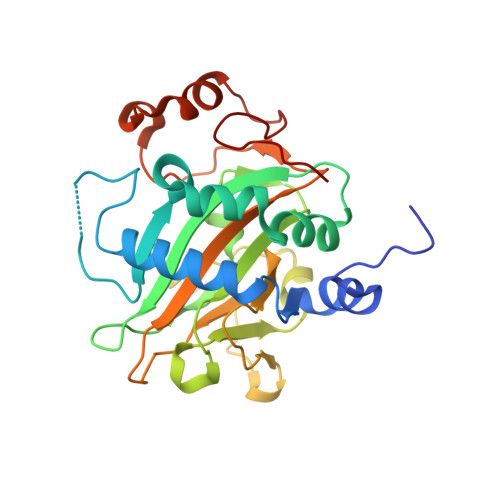
Nonheme Fe(II)/2-oxoglutarate (Fe/2-OG) dioxygenases carry out a broad range of oxidative reactions, yet α-hydroxylation of glycyl residues remains exceedingly rare. Here, we demonstrate that the Fe/2-OG enzyme MysH from Nostoc linckia performs this unusual chemistry during mycosporine-like amino acid biosynthesis, converting mono- and disubstituted precursors into palythines and revealing unexpected substrate tolerance. Kinetic isotope effects, detection of a transient hydroxylated intermediate, and glyoxylate byproduct formation support an α-hydroxylation-initiated mechanism. High-resolution crystal structures, complemented by molecular docking, molecular dynamics simulations, and site-directed mutagenesis, define an active-site architecture that positions the glycyl substrate in a near-transition-state geometry. Hybrid QM/MM calculations reveal a low-barrier hydrogen-atom-transfer step followed by hydroxyl rebound and implicate a conserved Trp125 in an electron-transfer network that lowers the activation barrier. Together, these findings establish a mechanistic framework for protein-directed α-glycine C-H activation by nonheme iron enzymes and provide a blueprint for engineering Fe/2-OG dioxygenases to expand the chemical diversity of mycosporines and related natural products.
- Department of Medicinal Chemistry and Center for Natural Products, Drug Discovery and Development (CNPD3), University of Florida, Gainesville, Florida 32610, United States.
Organizational Affiliation: