Download Mendeley
Conversion of Inactive Non-Pro1 Tautomerase Superfamily Members into Active Tautomerases: Analysis of the Pro1 Mutants.
Lancaster, E.B., Hardtke, H.A., Melkonian, T.R., Venkat Ramani, M., Johnson Jr., W.H., Baas, B.J., Zhang, Y.J., Whitman, C.P.(2025) Biochemistry 64: 812-822
- PubMed: 39914393 Search on PubMedSearch on PubMed Central
- DOI: https://doi.org/10.1021/acs.biochem.4c00338
- Primary Citation Related Structures:
9C4L, 9C6D - PubMed Abstract:
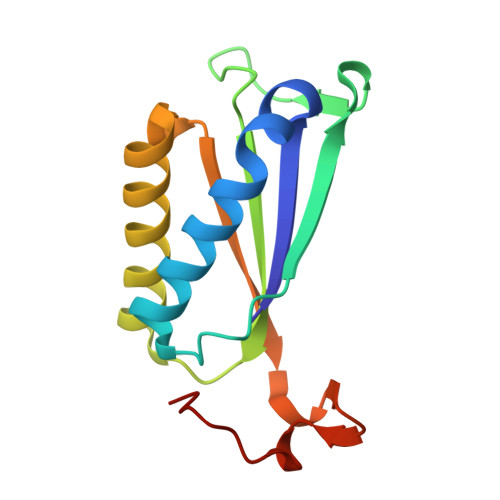
Pro1 is a critical catalytic residue in the characterized activities of tautomerase superfamily (TSF) members. Only a handful of members (∼346) lack Pro1 in a sequence similarity network (SSN) that consists of over 11,000 members. Most (294 members) are in the malonate semialdehyde decarboxylase (MSAD)-like subgroup, but the ones characterized thus far have little or no MSAD activity. Moreover, there is little to no activity with other TSF substrates. Five non-Pro1 members were selected randomly for kinetic [using phenylenolpyruvate (PP) and 2-hydroxymuconate (2HM)], mutagenic, inhibition, and crystallographic analysis. Using PP, k cat / K m values (∼10 1 -10 2 M -1 s -1 ) could be estimated for three native proteins whereas using 2HM, a k cat / K m value could only be estimated for one native protein (∼10 3 M -1 s -1 ). The k cat and K m values could not be determined. However, changing the N-terminal residue to a proline gave a significant improvement in k cat / K m values for all mutant enzymes using PP or 2HM. For PP, the k cat / K m values ranged from 10 3 -10 5 M -1 s -1 and for 2HM, the k cat / K m values ranged from 10 2 -10 4 M -1 s -1 . In addition, it was now possible to measure k cat and K m values for all mutant proteins using PP and one mutant protein using 2HM. Incubation of the Pro1 mutants with 3-bromopropiolate (3BP) results in covalent modification of the prolyl nitrogen of Pro1 by a 3-oxopropanoate adduct. Crystallographic analysis of two mutant enzymes (NJ7V1P and 8U6S1P) modified by the 3-oxopropanoate adduct identified binding ligands and suggest a mechanism for the tautomerase activity involving Pro1, Arg71, Tyr124, and the backbone amide of Phe68.
- Division of Chemical Biology and Medicinal Chemistry, College of Pharmacy, The University of Texas at Austin, Austin, Texas 78712, United States.
Organizational Affiliation: