Download Mendeley
Characterization of an isobutylene epoxide hydrolase (IbcK) from the isobutylene-catabolizing bacterium Mycolicibacterium sp. ELW1.
Faulkner, N.W., Joyce, J.B., Smith, C., Swartz, P., Rose, R.B., Miller, E.S., Hyman, M.R.(2025) Appl Environ Microbiol 91: e0039325-e0039325
- PubMed: 40856435 Search on PubMedSearch on PubMed Central
- DOI: https://doi.org/10.1128/aem.00393-25
- Primary Citation Related Structures:
9C2G - PubMed Abstract:
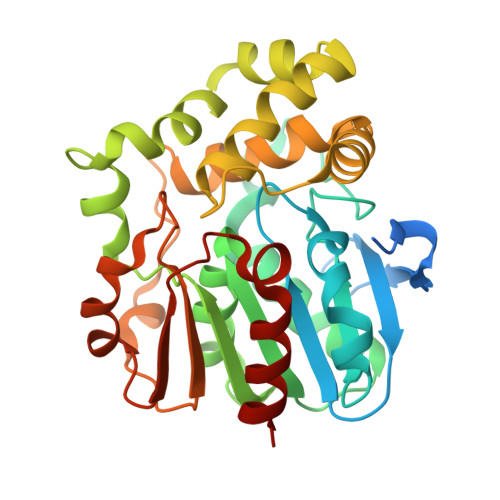
Isobutylene (IB) is produced on a large scale by the petrochemical industry and is metabolized by the aerobic alkene-metabolizing bacterium Mycolicibacterium sp. ELW1. The initial metabolite of IB catabolism by this bacterium is proposed to be 2-methyl-1,2-epoxypropane (isobutylene oxide [IBO]). The epoxide is then thought to be rapidly converted into 2-methyl-1,2-propanediol (MPD) by an epoxide hydrolase. A gene ( ibcK ) encoding a hydrolase is in a putative IB catabolism gene cluster on a ~222-kbp megaplasmid. This gene was cloned, heterologously expressed, and purified by Ni-NTA affinity chromatography. The purified protein rapidly and stoichiometrically hydrolyzed IBO to MPD with a specific activity of 29 µmoles min -1 mg protein -1 . Additional epoxides were also hydrolyzed by IbcK, including 1,2-epoxypropane, 1,2-epoxybutane, 1,2-epoxypentane, epichlorohydrin, and cyclohexane oxide, albeit at lower rates than IBO. IbcK also slowly hydrolyzed both cis - and trans -2,3-epoxybutane, which are the only other epoxides other than IBO known to support the growth of Mycolicibacterium sp. ELW1. Furthermore, IbcK also appears to be enantioselective towards chiral trans 2,3-epoxybutane. The crystal structure of IbcK was determined at 2.29 Å resolution, revealing a two-domain structure with an α/β hydrolase fold topology at its core. IbcK has high similarity to the epoxide hydrolase EchA from Agrobacterium radiobacter AD1, including the key active site residues Asp 117, Asp 256, and His 284. IbcK was observed to be in monomer-dimer equilibrium, which we propose occurs through interactions between the "cap" domains.IMPORTANCEThe initial metabolites generated during catabolism of volatile alkenes by aerobic alkene-oxidizing bacteria are consistently epoxides. These bacteria employ several different mechanisms to protect DNA, lipids, and proteins from damage by these reactive metabolites. The most common mechanisms are conjugation with coenzyme M or glutathione. In contrast, the role for hydrolases in the bacterial metabolism of volatile alkenes and their epoxides has not been frequently observed. The enzymatic, functional, and structural characterization of an epoxide hydrolase (IbcK) from the IB-utilizing bacterium Mycolicibacterium sp. ELW1 described here advances our understanding of these enzymes and suggests their potential application as an enantioselective catalyst. This study advances our understanding of how microorganisms utilize aliphatic alkenes, such as carbon and energy sources, including the role of epoxide hydrolases in these catabolic pathways.
- Department of Plant and Microbial Biology, North Carolina State University, Raleigh, North Carolina, USA.
Organizational Affiliation: