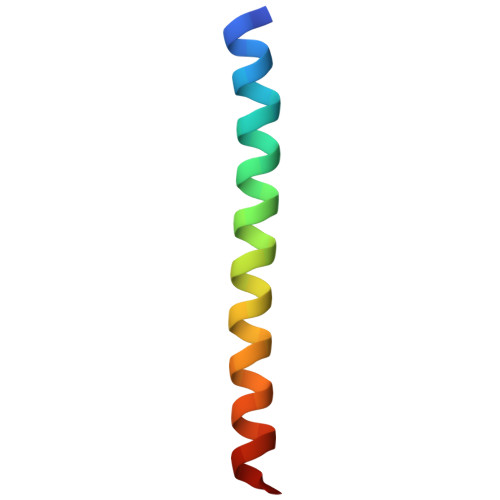
9BQR | pdb_00009bqr

X-ray Structure of a Second-Sphere H-bond Deletion Mutant of a De Novo Designed Self Assembled Peptide Tetramer Featuring a Cu(His)4(H2O) Coordination Motif


Experimental Data Snapshot

  • Method: X-RAY DIFFRACTION
  • Resolution: 1.47 Å
  • R-Value Free: 
    0.236 (Depositor), 0.245 (DCC) 
  • R-Value Work: 
    0.203 (Depositor), 0.215 (DCC) 
  • R-Value Observed: 
    0.205 (Depositor) 

Starting Model: experimental
View more details

wwPDB Validation 3D Report Full Report

Validation slider image for 9BQR

This is version 1.0 of the entry. See complete history. 

Literature

Controlling outer-sphere solvent reorganization energy to turn on or off the function of artificial metalloenzymes.

Prakash, D., Mitra, S., Sony, S., Murphy, M., Andi, B., Ashley, L., Prasad, P., Chakraborty, S.

(2025) Nat Commun 16: 3048-3048

  • DOI: https://doi.org/10.1038/s41467-025-57904-5
  • Primary Citation Related Structures: 
    8VHS, 9BQR

  • PubMed Abstract: 

    Metalloenzymes play essential roles in biology. However, unraveling how outer-sphere interactions can be predictably controlled to influence their functions remains a significant challenge. Inspired by Cu enzymes, we demonstrate how variations in the primary, secondary, and outer coordination-sphere interactions of de novo designed artificial copper proteins (ArCuPs) within trimeric (3SCC) and tetrameric (4SCC) self-assemblies-featuring a trigonal Cu(His) 3 and a square pyramidal Cu(His) 4 (OH 2 ) coordination-influence their catalytic and electron transfer properties. While 3SCC electrocatalyzes C-H oxidation, 4SCC does not. Cu I -3SCC reacts more rapidly with H 2 O 2 than O 2 , whereas 4SCC is less active. Electron transfer, reorganization energies, and extended H 2 O-mediated hydrogen bonding patterns provide insights into the observed reactivity differences. The inactivity of 4SCC is attributed to a significant solvent reorganization energy barrier mediated by a specific His---Glu hydrogen bond. When this hydrogen bond is disrupted, the solvent reorganization energy is reduced, and C-H peroxidation activity is restored.


  • Organizational Affiliation: 
    • Department of Chemistry and Biochemistry, University of Mississippi, University, MS, USA.

Macromolecule Content 

  • Total Structure Weight: 16.12 kDa 
  • Atom Count: 1,233 
  • Modeled Residue Count: 152 
  • Deposited Residue Count: 156 
  • Unique protein chains: 1

Macromolecules

Find similar proteins by:|  3D Structure
Entity ID: 1
MoleculeChains  Sequence LengthOrganismDetailsImage
K6E/E8K Double Mutant of Cu-4SCC
A, B, C, D
39synthetic constructMutation(s): 0 
Entity Groups
Sequence Clusters30% Identity50% Identity70% Identity90% Identity95% Identity100% Identity
Sequence Annotations
Expand
Reference Sequence

Small Molecules

Ligands 1 Unique
IDChains Name / Formula / InChI Key2D Diagram3D Interactions
CU
(Subject of Investigation/LOI)

Query on CU


Download:Ideal Coordinates CCD File
E [auth A]COPPER (II) ION
Cu
JPVYNHNXODAKFH-UHFFFAOYSA-N

Experimental Data & Validation

Experimental Data

  • Method: X-RAY DIFFRACTION
  • Resolution: 1.47 Å
  • R-Value Free:  0.236 (Depositor), 0.245 (DCC) 
  • R-Value Work:  0.203 (Depositor), 0.215 (DCC) 
  • R-Value Observed: 0.205 (Depositor) 
Space Group: P 1 21 1
Unit Cell:
Length ( Å )Angle ( ˚ )
a = 34.553α = 90
b = 45.309β = 98.54
c = 40.524γ = 90
Software Package:
Software NamePurpose
REFMACrefinement
XDSdata scaling
XDSdata reduction
PHASERphasing

Structure Validation

View Full Validation Report


Entry History 

& Funding Information

Deposition Data


Funding OrganizationLocationGrant Number
Other private--

Revision History  (Full details and data files)

  • Version 1.0: 2025-04-16
    Type: Initial release