Download Mendeley
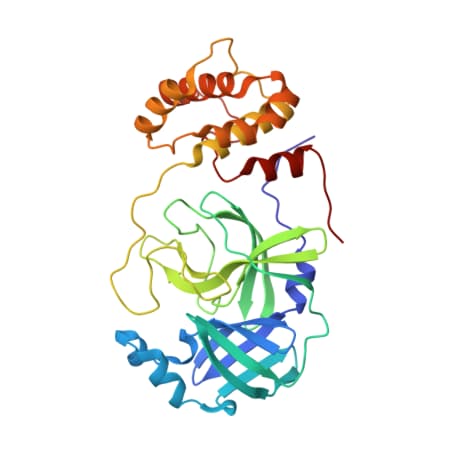
Disulfide bond formation between Cys22 and Cys44 in SARS-CoV-2 main protease.
Blankenship, L.R., Yang, K., Cho, C.D., Chen, Y.P., Sankaran, B., Liu, W.R.(2026) Bioorg Med Chem Lett 139: 130692-130692
- PubMed: 42190838 Search on PubMedSearch on PubMed Central
- DOI: https://doi.org/10.1016/j.bmcl.2026.130692
- Primary Citation Related Structures:
9BQF, 9BQG, 9BQY, 9BS8 - PubMed Abstract:
SARS-CoV-2 main protease (M Pro ) is a cysteine enzyme essential for viral replication and pathogenesis. It contains multiple cysteines that are susceptible to covalent modifications. Reported modifications include inhibitor-derived modifications at the catalytic Cys145, Cys145-Cys117 disulfide, an S-O-N (SON) crosslink between Cys22 and Lys61, and S-O-N-O-S (SONOS) crosslink spanning Cys22-Lys61-Cys44, Cys300 S-glutathionylation, and inhibitor-derived adducts on Cys156 and Cys300. Reanalysis of M Pro crystal structures obtained from samples exposed to air identified nine structures containing the SON crosslink and thirty-one containing the SONOS crosslink. Among five newly determined structures, one unexpectedly showed a Cys22-Cys44 disulfide. Cys44 lies in a segment that contributes to the active site architecture but is flexible to adopt alternative conformations. Redox transformations at this position by formation of either SONOS crosslink or disulfide suggest potential redox regulation of M Pro activity in host cells experiencing virus-induced oxidative stress. A C22S mutant enzyme displays much higher activity than wild type enzyme supporting potential redox regulation mechanisms involving Cys22 and Cys44.
- Texas A&M Drug Discovery Center and Department of Chemistry, Texas A&M University, College Station, TX 77843, USA.
Organizational Affiliation: