Download Mendeley
A broadly protective human antibody for GI genogroup noroviruses.
Rimkute, I., Olia, A.S., Suleiman, M., Woods, K.D., Bylund, T., Morano, N.C., Tully, E.S., Verardi, R., Bao, S., Beddall, M.H., Chaimongkol, N., Donaldson, M.M., Du, R., Dulan, C.N.M., Gorman, J., Henry, A.R., Schramm, C.A., Sosnovtsev, S.V., Stephens, T., Todd, J.P., Tsybovsky, Y., Douek, D.C., Green, K.Y., Rawi, R., Shapiro, L., Zhou, T., Kwong, P.D., Roederer, M.(2025) Nat Microbiol 10: 1227-1239
- PubMed: 40211068 Search on PubMedSearch on PubMed Central
- DOI: https://doi.org/10.1038/s41564-025-01952-6
- Primary Citation Related Structures:
9BOF - PubMed Abstract:
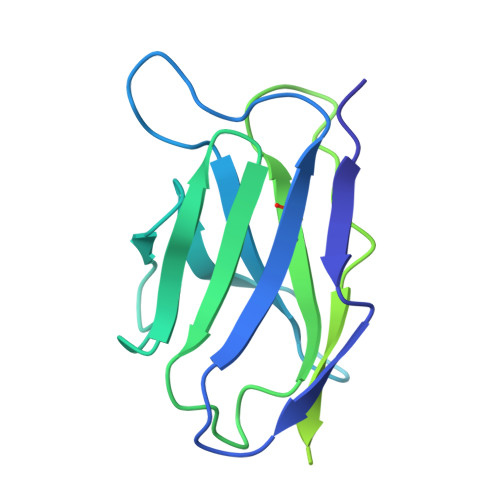
Noroviruses infect millions each year, and while effective countermeasures are eagerly sought, none have been reported for the GI genogroup, first described more than 50 years ago. Here, to provide insight into GI norovirus neutralization, we isolated a broad GI antibody, 16E10, from a human blood donor and showed it neutralizes noroviruses in human enteroid cultures and abrogates or reduces infection in rhesus macaques. The cryogenic electron microscopy reconstruction of 16E10 with a norovirus protruding-domain dimer at 2.56-Å resolution reveals an exceptionally large binding surface, overlapping an antibody supersite, distal from host receptor-binding or cofactor-binding sites. Cryogenic electron microscopy reconstructions with virus-like particles (VLPs) showed that 16E10 disrupts protruding domains on the VLP surface and disassembles VLPs, altering viral organization required for avidity. While its epitope was generally conserved, 16E10 recognized multiple sequence-divergent residues, binding to which was enabled by corresponding cavities in the 16E10-norovirus interface. Broad recognition of noroviruses can thus incorporate sequence-divergent residues, through a cavity-based mechanism of diversity tolerance.
- Vaccine Research Center, National Institute of Allergy and Infectious Diseases (NIAID), National Institutes of Health (NIH), Bethesda, MD, USA.
Organizational Affiliation: