9BIN | pdb_00009bin

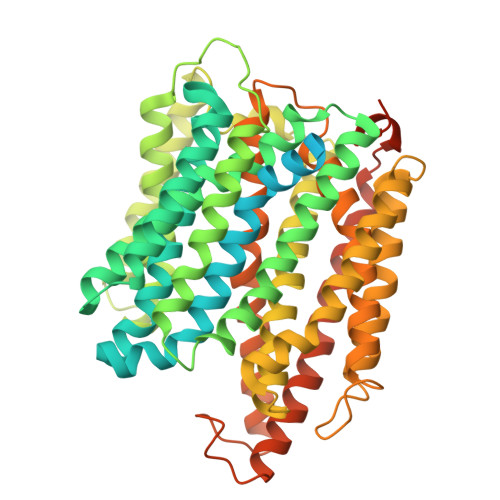
BRD-8000.3 bound EFPA transporter of Mycobacterium tuberculosis


Experimental Data Snapshot

  • Method: ELECTRON MICROSCOPY
  • Resolution: 3.45 Å
  • Aggregation State: PARTICLE 
  • Reconstruction Method: SINGLE PARTICLE 

Starting Model: in silico
View more details

wwPDB Validation   3D Report Full Report


This is version 1.2 of the entry. See complete history


Literature

Structure and inhibition mechanisms of Mycobacterium tuberculosis essential transporter efflux protein A.

Khandelwal, N.K.Gupta, M.Gomez, J.E.Barkho, S.Guan, Z.Eng, A.Y.Kawate, T.Balasubramani, S.G.Sali, A.Hung, D.T.Stroud, R.M.

(2025) Nat Commun 16: 3139-3139

  • DOI: https://doi.org/10.1038/s41467-025-58133-6
  • Primary Citation of Related Structures:  
    9BII, 9BIN, 9BIQ, 9BL7

  • PubMed Abstract: 

    A broad chemical genetic screen in Mycobacterium tuberculosis (Mtb) identified compounds (BRD-8000.3 and BRD-9327) that inhibit the essential efflux pump EfpA. To understand the mechanisms of inhibition, we determined the structures of EfpA with these inhibitors bound at 2.7-3.4 Å resolution. Our structures reveal different mechanisms of inhibition by the two inhibitors. BRD-8000.3 binds in a tunnel contacting the lipid bilayer and extending toward the central cavity to displace the fatty acid chain of a lipid molecule bound in the apo structure, suggesting its blocking of an access route for a natural lipidic substrate. Meanwhile, BRD-9327 binds in the outer vestibule without complete blockade of the substrate path to the outside, suggesting its possible inhibition of the movement necessary for alternate access of the transporter. Our results show EfpA as a potential lipid transporter, explain the basis of the synergy of these inhibitors and their potential for combination anti-tuberculosis therapy.


  • Organizational Affiliation
    • Department of Biochemistry and Biophysics, University of California San Francisco, San Francisco, CA, USA.

Macromolecules
Find similar proteins by:  (by identity cutoff)  |  3D Structure
Entity ID: 1
MoleculeChains Sequence LengthOrganismDetailsImage
Uncharacterized MFS-type transporter EfpA
A, B
629Mycobacterium tuberculosis H37RvMutation(s): 1 
Gene Names: efpARv2846c
UniProt
Find proteins for P9WJY5 (Mycobacterium tuberculosis (strain ATCC 25618 / H37Rv))
Explore P9WJY5 
Go to UniProtKB:  P9WJY5
Entity Groups  
Sequence Clusters30% Identity50% Identity70% Identity90% Identity95% Identity100% Identity
UniProt GroupP9WJY5
Sequence Annotations
Expand
  • Reference Sequence
Small Molecules
Ligands 3 Unique
IDChains Name / Formula / InChI Key2D Diagram3D Interactions
A1H2V (Subject of Investigation/LOI)
Query on A1H2V

Download Ideal Coordinates CCD File 
D [auth A],
G [auth B]
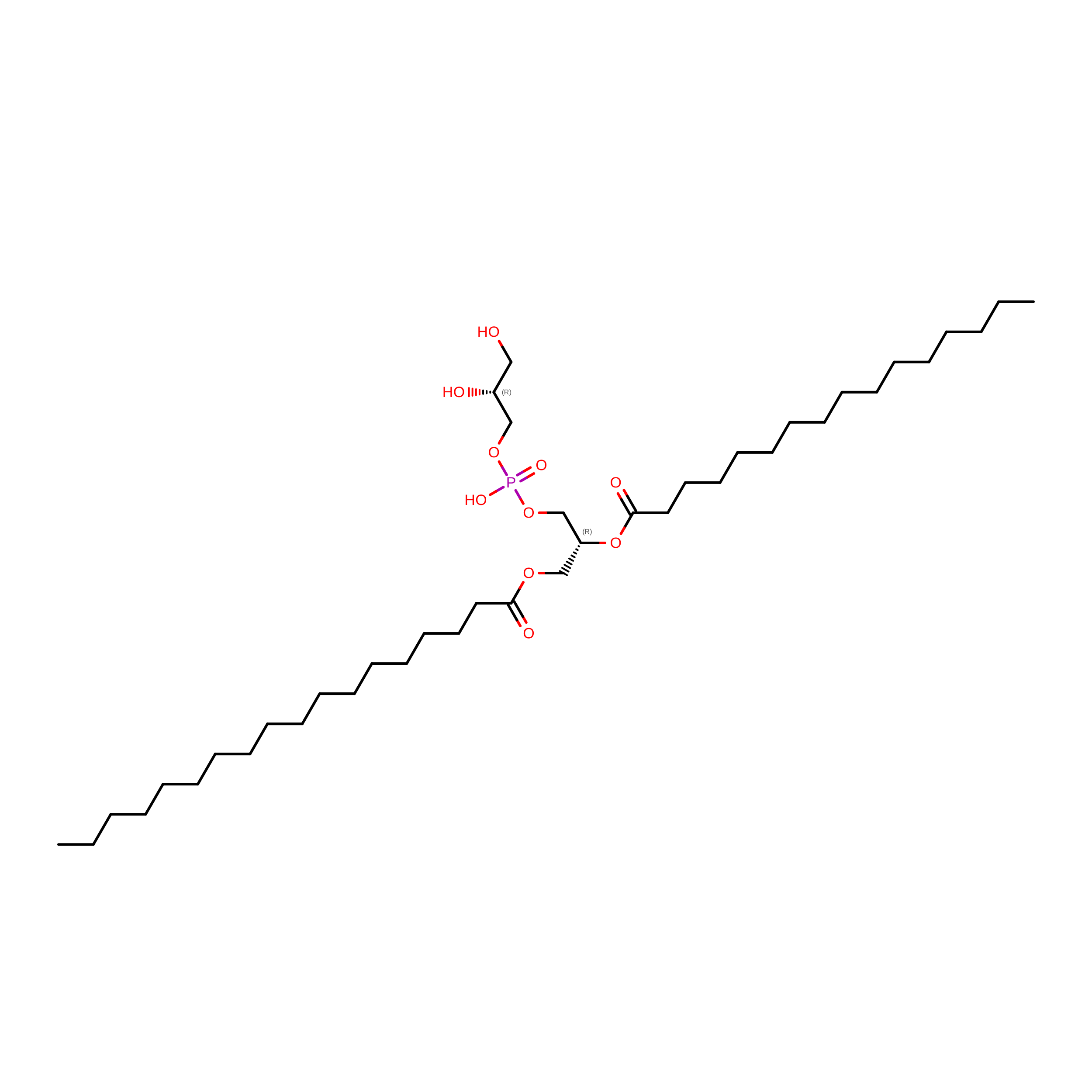
[(2~{R})-3-[[(2~{R})-2,3-bis(oxidanyl)propoxy]-oxidanyl-phosphoryl]oxy-2-hexadecanoyloxy-propyl] octadecanoate
C40 H79 O10 P
WYVBOKLMHDFYQD-XPSQVAKYSA-N
Y01 (Subject of Investigation/LOI)
Query on Y01

Download Ideal Coordinates CCD File 
E [auth A],
H [auth B]
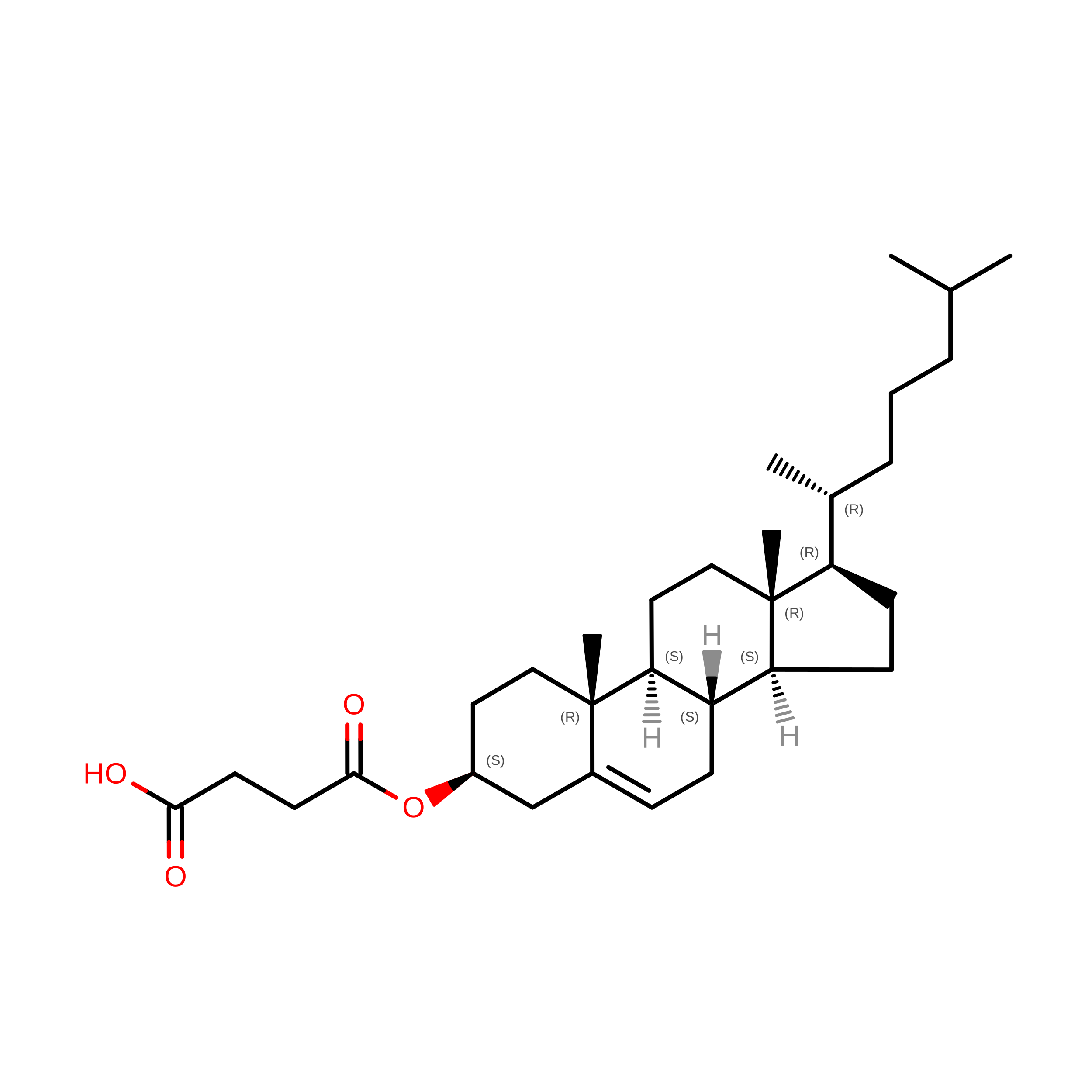
CHOLESTEROL HEMISUCCINATE
C31 H50 O4
WLNARFZDISHUGS-MIXBDBMTSA-N
A1AQR (Subject of Investigation/LOI)
Query on A1AQR

Download Ideal Coordinates CCD File 
C [auth A],
F [auth B]
(1S,3S)-N-[6-bromo-5-(pyrimidin-2-yl)pyridin-2-yl]-2,2-dimethyl-3-(2-methylprop-1-en-1-yl)cyclopropane-1-carboxamide
C19 H21 Br N4 O
XIITZGMKUBIQRI-DZGCQCFKSA-N
Experimental Data & Validation

Experimental Data

  • Method: ELECTRON MICROSCOPY
  • Resolution: 3.45 Å
  • Aggregation State: PARTICLE 
  • Reconstruction Method: SINGLE PARTICLE 
EM Software:
TaskSoftware PackageVersion
MODEL REFINEMENTPHENIX
RECONSTRUCTIONcryoSPARCv4.2.1

Structure Validation

View Full Validation Report


Entry History & Funding Information

Deposition Data


Funding OrganizationLocationGrant Number
National Institutes of Health/National Institute of General Medical Sciences (NIH/NIGMS)United StatesGM024485

Revision History  (Full details and data files)

  • Version 1.0: 2025-02-05
    Type: Initial release
  • Version 1.1: 2025-06-04
    Changes: Data collection
  • Version 1.2: 2025-08-27
    Changes: Data collection, Database references