9BHT | pdb_00009bht

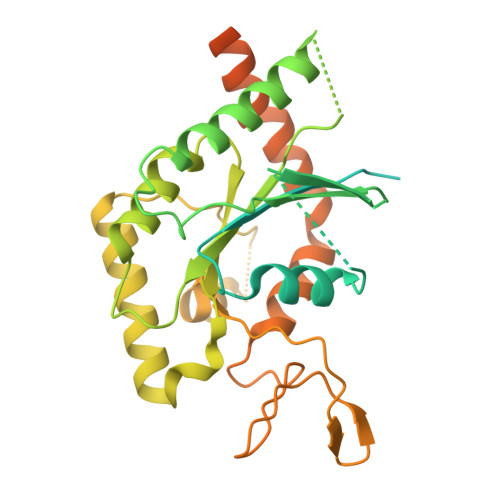
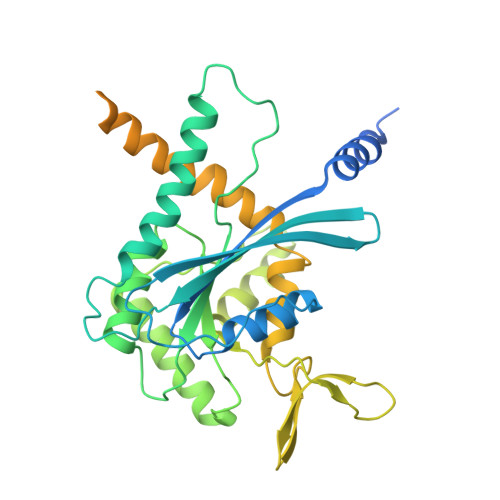
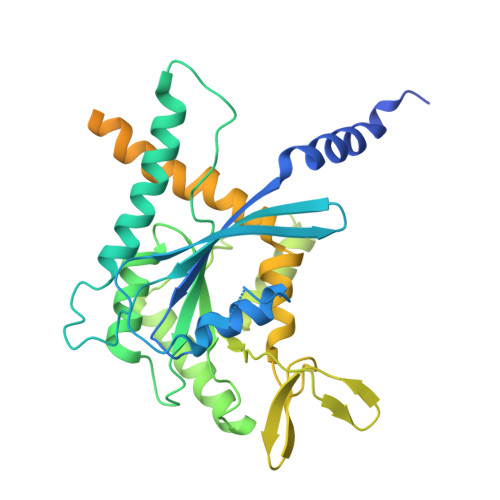
Septin Hexameric Complex SEPT2/SEPT6/SEPT7 of Ciona intestinalis by Cryo-EM


Experimental Data Snapshot

  • Method: ELECTRON MICROSCOPY
  • Resolution: 3.26 Å
  • Aggregation State: PARTICLE 
  • Reconstruction Method: SINGLE PARTICLE 

wwPDB Validation   3D Report Full Report


This is version 1.2 of the entry. See complete history


Literature

Structural Insights into Ciona intestinalis Septins: Complexes Suggest a Mechanism for Nucleotide-dependent Interfacial Cross-talk.

Mendonca, D.C.Morais, S.T.B.Ciol, H.Pinto, A.P.A.Leonardo, D.A.Pereira, H.D.Valadares, N.F.Portugal, R.V.Klaholz, B.P.Garratt, R.C.Araujo, A.P.U.

(2024) J Mol Biology 436: 168693-168693

  • DOI: https://doi.org/10.1016/j.jmb.2024.168693
  • Primary Citation of Related Structures:  
    9BHT, 9BHW

  • PubMed Abstract: 

    Septins are filamentous nucleotide-binding proteins which can associate with membranes in a curvature-dependent manner leading to structural remodelling and barrier formation. Ciona intestinalis, a model for exploring the development and evolution of the chordate lineage, has only four septin-coding genes within its genome. These represent orthologues of the four classical mammalian subgroups, making it a minimalist non-redundant model for studying the modular assembly of septins into linear oligomers and thereby filamentous polymers. Here, we show that C. intestinalis septins present a similar biochemistry to their human orthologues and also provide the cryo-EM structures of an octamer, a hexamer and a tetrameric sub-complex. The octamer, which has the canonical arrangement (2-6-7-9-9-7-6-2) clearly shows an exposed NC-interface at its termini enabling copolymerization with hexamers into mixed filaments. Indeed, only combinations of septins which had CiSEPT2 occupying the terminal position were able to assemble into filaments via NC-interface association. The CiSEPT7-CiSEPT9 tetramer is the smallest septin particle to be solved by Cryo-EM to date and its good resolution (2.7 Å) provides a well-defined view of the central NC-interface. On the other hand, the CiSEPT7-CiSEPT9 G-interface shows signs of fragility permitting toggling between hexamers and octamers, similar to that seen in human septins but not in yeast. The new structures provide insights concerning the molecular mechanism for cross-talk between adjacent interfaces. This indicates that C. intestinalis may represent a valuable tool for future studies, fulfilling the requirements of a complete but simpler system to understand the mechanisms behind the assembly and dynamics of septin filaments.


  • Organizational Affiliation
    • São Carlos Institute of Physics, USP, São Carlos, SP, Brazil.

Macromolecules
Find similar proteins by:  (by identity cutoff)  |  3D Structure
Entity ID: 1
MoleculeChains Sequence LengthOrganismDetailsImage
CiSeptin-2
A, F
445Ciona intestinalisMutation(s): 0 
UniProt
Find proteins for A0AAX7FM32 (Ciona intestinalis)
Explore A0AAX7FM32 
Go to UniProtKB:  A0AAX7FM32
Entity Groups  
Sequence Clusters30% Identity50% Identity70% Identity90% Identity95% Identity100% Identity
UniProt GroupA0AAX7FM32
Sequence Annotations
Expand
  • Reference Sequence
Find similar proteins by:  (by identity cutoff)  |  3D Structure
Entity ID: 2
MoleculeChains Sequence LengthOrganismDetailsImage
CiSeptin-6
B, E
429Ciona intestinalisMutation(s): 0 
UniProt
Find proteins for F6V5P8 (Ciona intestinalis)
Explore F6V5P8 
Go to UniProtKB:  F6V5P8
Entity Groups  
Sequence Clusters30% Identity50% Identity70% Identity90% Identity95% Identity100% Identity
UniProt GroupF6V5P8
Sequence Annotations
Expand
  • Reference Sequence
Find similar proteins by:  (by identity cutoff)  |  3D Structure
Entity ID: 3
MoleculeChains Sequence LengthOrganismDetailsImage
CiSeptin-7
C, D
419Ciona intestinalisMutation(s): 0 
UniProt
Find proteins for H2Y169 (Ciona intestinalis)
Explore H2Y169 
Go to UniProtKB:  H2Y169
Entity Groups  
Sequence Clusters30% Identity50% Identity70% Identity90% Identity95% Identity100% Identity
UniProt GroupH2Y169
Sequence Annotations
Expand
  • Reference Sequence
Experimental Data & Validation

Experimental Data

  • Method: ELECTRON MICROSCOPY
  • Resolution: 3.26 Å
  • Aggregation State: PARTICLE 
  • Reconstruction Method: SINGLE PARTICLE 
EM Software:
TaskSoftware PackageVersion
MODEL REFINEMENTPHENIX1.20.1_4487:

Structure Validation

View Full Validation Report


Entry History & Funding Information

Deposition Data


Funding OrganizationLocationGrant Number
Sao Paulo Research Foundation (FAPESP)Brazil2021/10247-0
Sao Paulo Research Foundation (FAPESP)Brazil2023/06866-1
Sao Paulo Research Foundation (FAPESP)Brazil2020/02897-1

Revision History  (Full details and data files)

  • Version 1.0: 2024-07-10
    Type: Initial release
  • Version 1.1: 2024-07-17
    Changes: Data collection, Database references
  • Version 1.2: 2024-07-24
    Changes: Data collection, Database references