9BFM | pdb_00009bfm

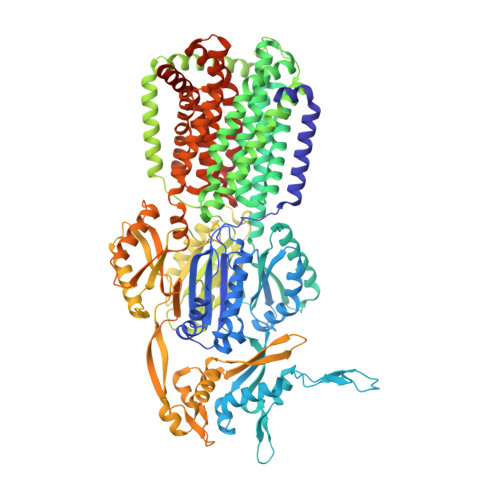
Cryo-EM co-structure of AcrB with the EPM35 efflux pump inhibitor


Experimental Data Snapshot

  • Method: ELECTRON MICROSCOPY
  • Resolution: 2.71 Å
  • Aggregation State: PARTICLE 
  • Reconstruction Method: SINGLE PARTICLE 

wwPDB Validation 3D Report Full Report

Validation slider image for 9BFM

This is version 1.1 of the entry. See complete history

Literature

Bacterial efflux pump modulators prevent bacterial growth in macrophages and under broth conditions that mimic the host environment.

Allgood, S.C.Su, C.C.Crooks, A.L.Meyer, C.T.Zhou, B.Betterton, M.D.Barbachyn, M.R.Yu, E.W.Detweiler, C.S.

(2023) mBio 14: e0249223

  • DOI: https://doi.org/10.1128/mbio.02492-23
  • Primary Citation Related Structures: 
    9BFH, 9BFM, 9BFN, 9BFT

  • PubMed Abstract: 

    Bacterial efflux pumps are critical for resistance to antibiotics and for virulence. We previously identified small molecules that inhibit efflux pumps (efflux pump modulators, EPMs) and prevent pathogen replication in host cells. Here, we used medicinal chemistry to increase the activity of the EPMs against pathogens in cells into the nanomolar range. We show by cryo-electron microscopy that these EPMs bind an efflux pump subunit. In broth culture, the EPMs increase the potency (activity), but not the efficacy (maximum effect), of antibiotics. We also found that bacterial exposure to the EPMs appear to enable the accumulation of a toxic metabolite that would otherwise be exported by efflux pumps. Thus, inhibitors of bacterial efflux pumps could interfere with infection not only by potentiating antibiotics, but also by allowing toxic waste products to accumulate within bacteria, providing an explanation for why efflux pumps are needed for virulence in the absence of antibiotics.


  • Organizational Affiliation
    • Molecular, Cellular, and Developmental Biology, University of Colorado Boulder, Boulder, Colorado, USA.

Macromolecule Content 

  • Total Structure Weight: 341.46 kDa 
  • Atom Count: 23,597 
  • Modeled Residue Count: 3,100 
  • Deposited Residue Count: 3,147 
  • Unique protein chains: 1

Macromolecules

Find similar proteins by:|  3D Structure
Entity ID: 1
MoleculeChains  Sequence LengthOrganismDetailsImage
Multidrug efflux pump subunit AcrB
A, B, C
1,049Escherichia coli K-12Mutation(s): 0 
Gene Names: acrBacrEb0462JW0451
Membrane Entity: Yes 
UniProt
Find proteins for P31224 (Escherichia coli (strain K12))
Explore P31224 
Go to UniProtKB:  P31224
Entity Groups
Sequence Clusters30% Identity50% Identity70% Identity90% Identity95% Identity100% Identity
UniProt GroupP31224
Sequence Annotations
Expand
Reference Sequence

Small Molecules

Ligands 1 Unique
IDChains Name / Formula / InChI Key2D Diagram3D Interactions
A1AON
(Subject of Investigation/LOI)

Query on A1AON


Download:Ideal Coordinates CCD File
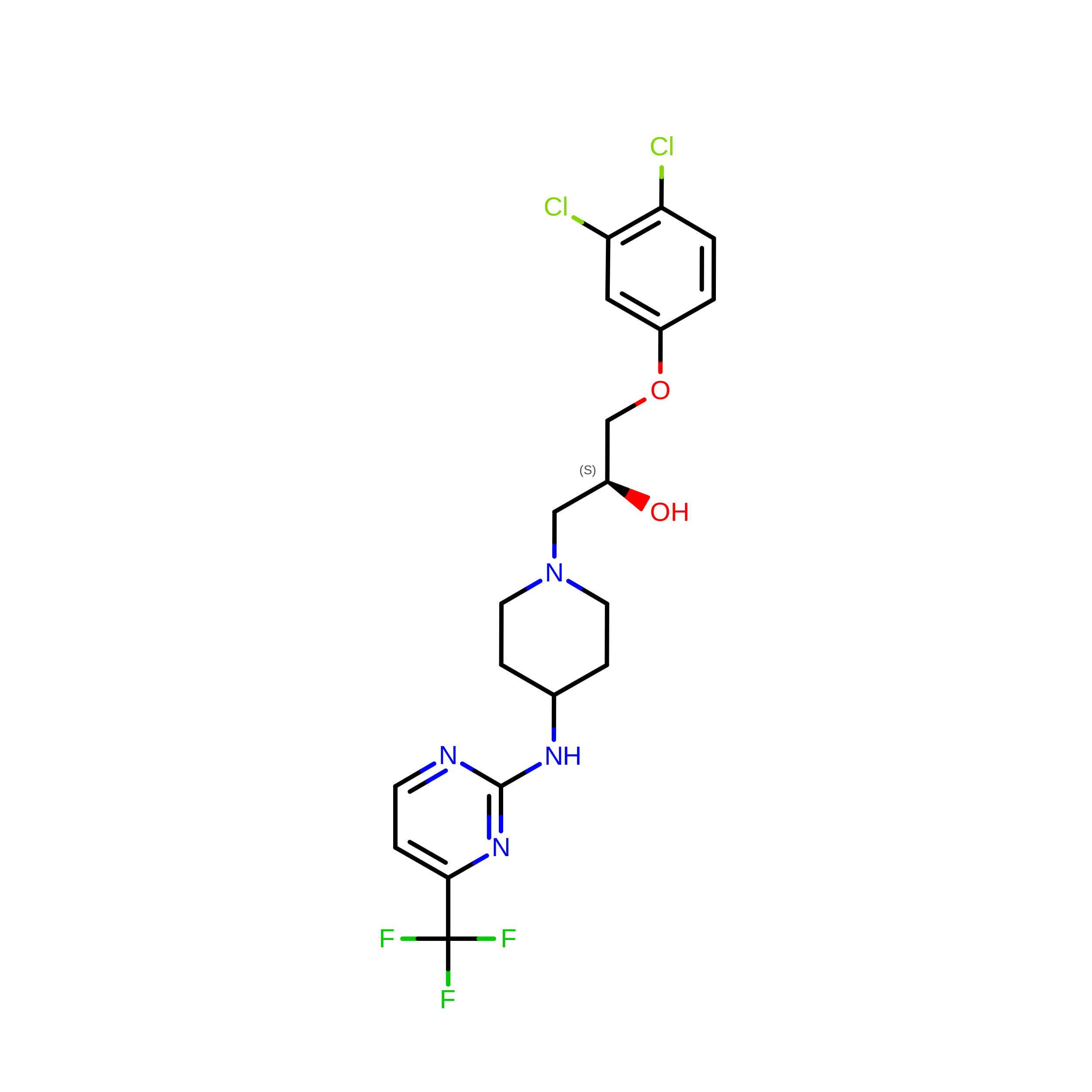
D [auth A](2S)-1-(3,4-dichlorophenoxy)-3-(4-{[4-(trifluoromethyl)pyrimidin-2-yl]amino}piperidin-1-yl)propan-2-ol
C19 H21 Cl2 F3 N4 O2
DEXPLCIUOWIUDC-ZDUSSCGKSA-N

Experimental Data & Validation

Experimental Data

  • Method: ELECTRON MICROSCOPY
  • Resolution: 2.71 Å
  • Aggregation State: PARTICLE 
  • Reconstruction Method: SINGLE PARTICLE 
EM Software:
TaskSoftware PackageVersion
MODEL REFINEMENTPHENIX

Structure Validation

View Full Validation Report


Entry History 

& Funding Information

Deposition Data

  • Released Date: 2024-05-08 
  • Deposition Author(s): Su, C.C.

Funding OrganizationLocationGrant Number
National Institutes of Health/National Institute Of Allergy and Infectious Diseases (NIH/NIAID)United States--

Revision History  (Full details and data files)

  • Version 1.0: 2024-05-08
    Type: Initial release
  • Version 1.1: 2025-05-21
    Changes: Data collection, Structure summary