Download Mendeley
Molecular Basis for the Activation of Pseudomonas aeruginosa MsbA by Divalent Metals.
Lyu, J., Bahramimoghaddam, H., Zhang, T., Scott, E., Yun, S.D., Yadav, G.P., Zhao, M., Russell, D., Laganowsky, A.(2025) J Am Chem Soc 147: 31488-31496
- PubMed: 40851428 Search on PubMedSearch on PubMed Central
- DOI: https://doi.org/10.1021/jacs.4c18759
- Primary Citation Related Structures:
9BD6, 9BD7 - PubMed Abstract:
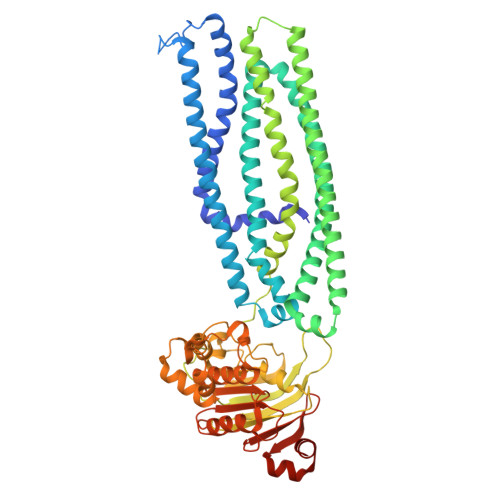
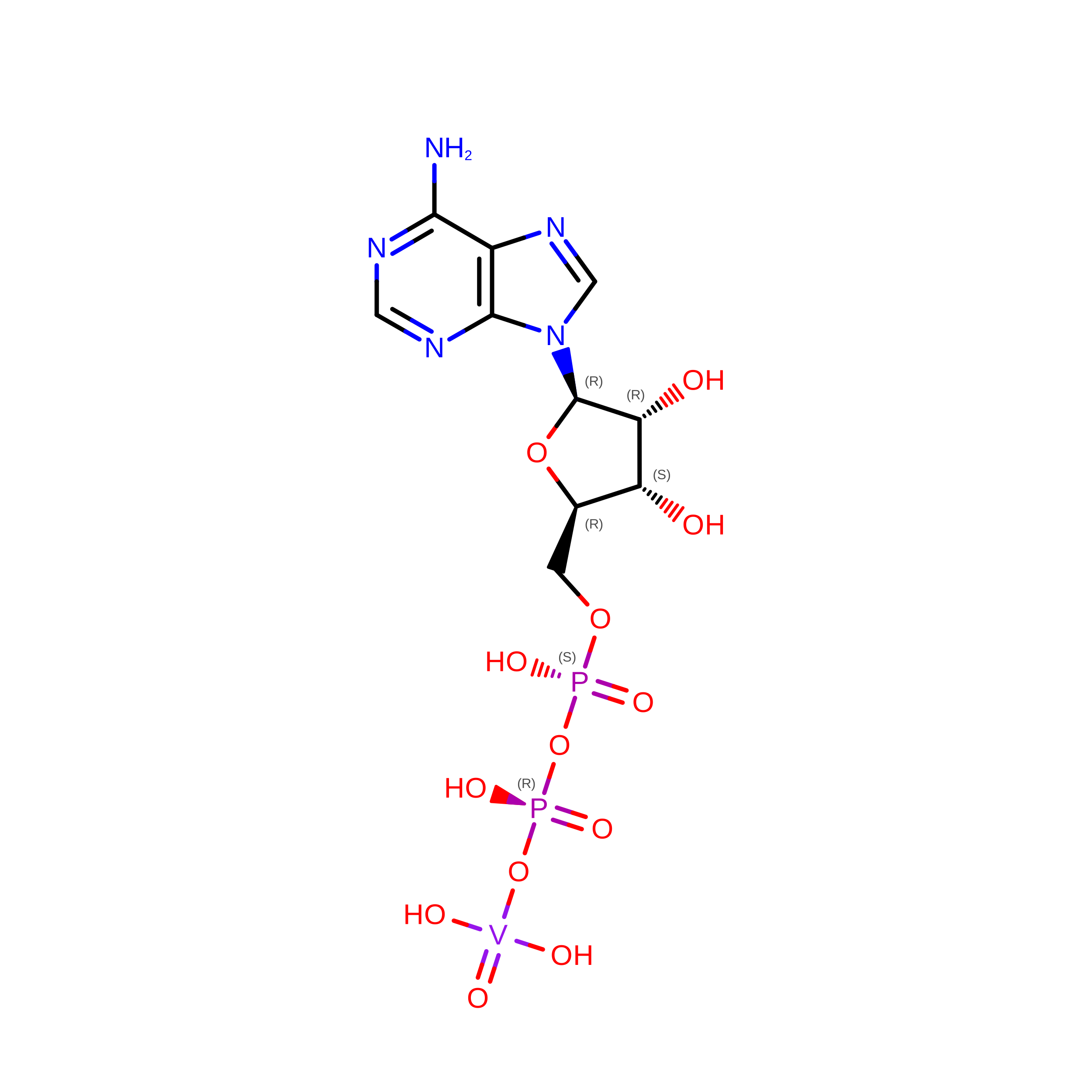
Proteins involved in the biogenesis of lipopolysaccharide (LPS), a lipid exclusive to Gram-negative bacteria, are promising candidates for drug discovery. Specifically, the ABC transporter MsbA plays a crucial role in translocating an LPS precursor from the cytoplasmic to the periplasmic facing leaflet of the inner membrane, and small molecules that inhibit its function exhibit bactericidal activity. Here, we use native mass spectrometry (MS) to determine lipid binding affinities of MsbA from P. aeruginosa (PaMsbA), a Gram-negative bacteria associated with hospital-acquired infections, in different conformations. Unlike the transporter from E. coli , we show that the ATPase activity of PaMsbA is stimulated by Zn 2+ , Ni 2+ , and Mn 2+ and successfully trapping the protein with vanadate requires one of these metal ions. We also present cryogenic-electron microscopy structures of PaMsbA in occluded and open outward-facing conformations determined to resolutions of 2.58 and 2.44 Å, respectively. The structures reveal a triad of histidine residues, and mutation of these residues abolishes Zn 2+ binding and stimulation of PaMsbA activity by metal ions. Together, our studies provide insight into the structure of PaMsbA and its lipid binding preferences and reveal that a subset of divalent metals stimulates its ATPase activity.
- Department of Chemistry, Texas A&M University, College Station, Texas 77843, United States.
Organizational Affiliation: