Download Mendeley
Structural and biochemical characterization of a thermostable Bacillus subtilis L-asparaginase with antiproliferative effects on hematological cancer cell lines.
Brandao, L.C., da Silva Gomes, J.G., Pinheiro, D.P., Caetano, L.F., Bezerra, M.R.L., Pontes, L.Q., Pinheiro, M.P., de Aquino, A.V.F.G., Silva, J.M.F., Souza, P.F.N., Furtado, C.L.M., Pessoa, C., Lourenzoni, M.R., da Rocha, B.A.M., Furtado, G.P.(2025) Int J Biol Macromol 333: 148804-148804
- PubMed: 41203148 Search on PubMed
- DOI: https://doi.org/10.1016/j.ijbiomac.2025.148804
- Primary Citation Related Structures:
9BAD - PubMed Abstract:
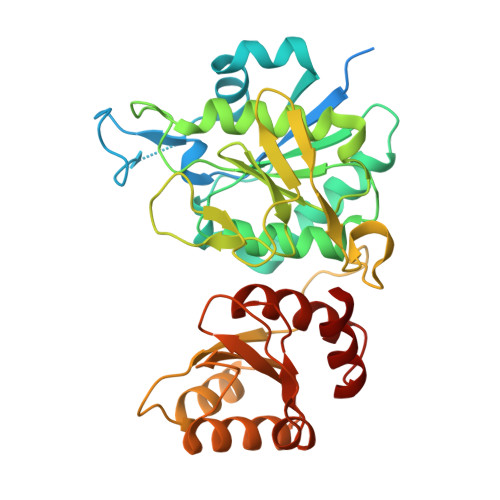
L-asparaginase catalyzes the hydrolysis of L-asparagine into aspartic acid and ammonia and is found in animals, plants, and microorganisms. Microbial sources are preferred for large-scale production due to their efficiency and ease of cultivation. In this study, we produced and characterized a recombinant L-asparaginase from Bacillus subtilis (Asp-Z). Asp-Z was heterologously expressed in Escherichia coli and purified by affinity chromatography, yielding soluble protein with optimal activity at 55 °C and pH 7.5. The kinetic parameters under these conditions were a Km of 0.47 mM and a Vmax of 52.13 U/mg. Asp-Z was specific for L-asparagine, showing no detectable glutaminase activity, and exhibited antiproliferative effects against hematological cancer cell lines, particularly RAJI and JURKAT, with IC₅₀ values in the micromolar range. In silico analysis revealed distinct immunogenic epitopes between Asp-Z and the commercial E. coli L-asparaginase, suggesting divergent antigenic profiles, whereas crystallographic data revealed a conserved tetrameric fold with a highly flexible active-site loop. Together, these findings highlight Asp-Z as a thermostable, glutaminase-free, and poorly immunogenic enzyme that represents a promising scaffold for optimization through protein engineering toward therapeutic and biotechnological applications.
- Protein Engineering and Health Solutions Group (GEPeSS), Oswaldo Cruz Foundation (Fiocruz), Eusébio, Ceará, Brazil; Graduate Program in Biotechnology of Natural Resources (PPGBiotec), Department of Fisheries Engineering, Federal University of Ceará, Fortaleza, Ceará, Brazil.
Organizational Affiliation: