Download Mendeley
Solution structures and effects of a platinum compound successively bound MYC G-quadruplex.
Liu, W., Zhu, B.C., Liu, L.Y., Xia, X.Y., Jang, J., Dickerhoff, J., Yang, D., Mao, Z.W.(2024) Nucleic Acids Res 52: 9397-9406
- PubMed: 39077944 Search on PubMedSearch on PubMed Central
- DOI: https://doi.org/10.1093/nar/gkae649
- Primary Citation Related Structures:
8YU3, 9B6Z - PubMed Abstract:
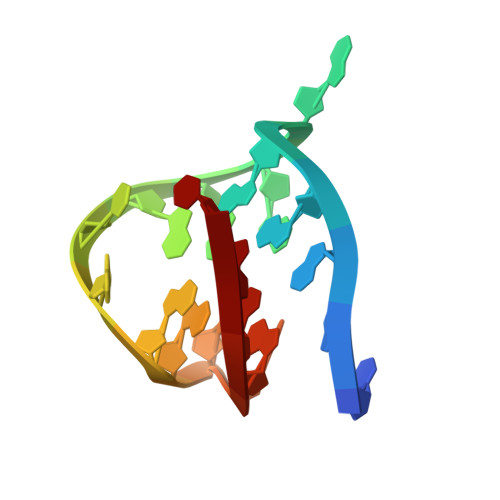
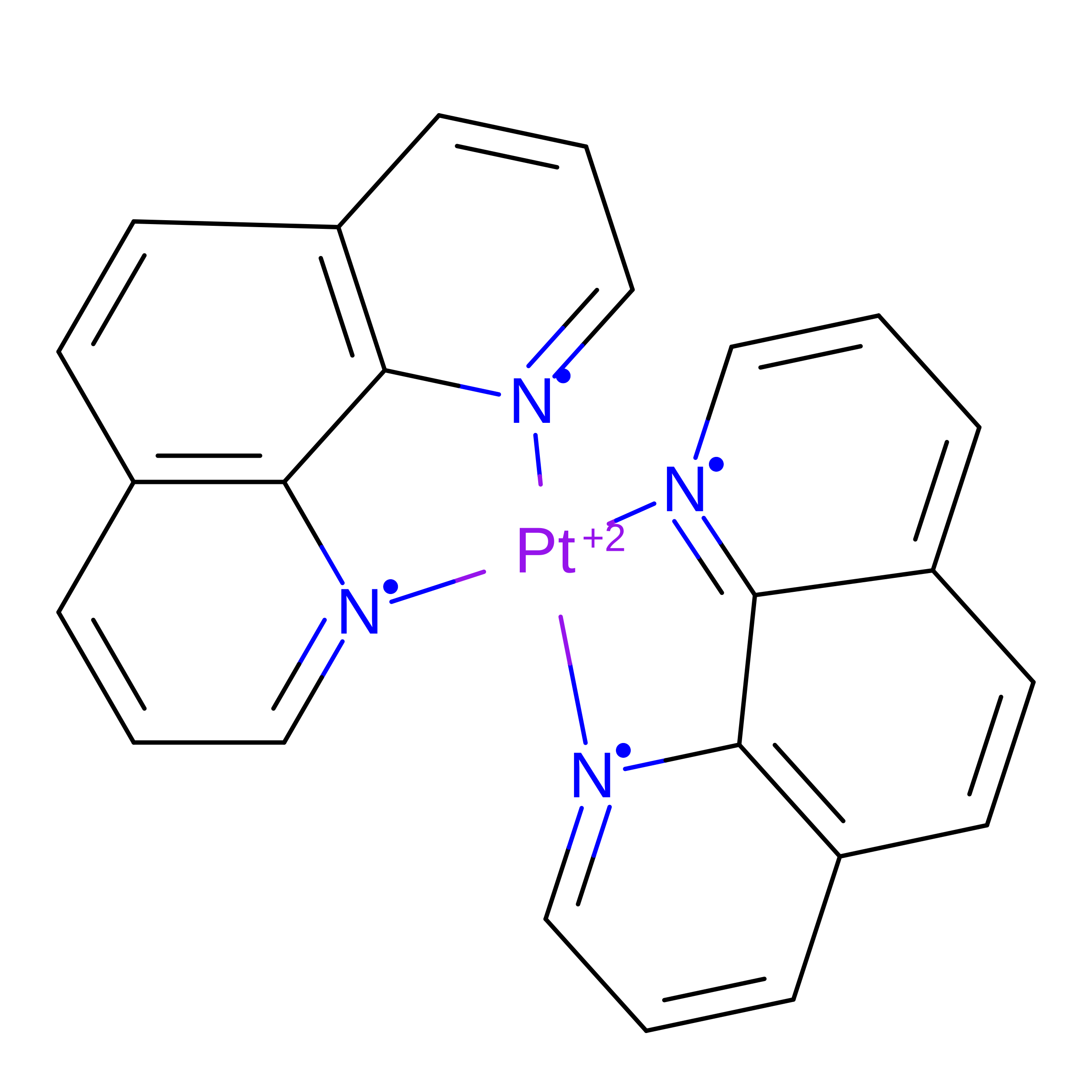
G-quadruplex (G4) structures play integral roles in modulating biological functions and can be regulated by small molecules. The MYC gene is critical during tumor initiation and malignant progression, in which G4 acts as an important modulation motif. Herein, we reported the MYC promoter G4 recognized by a platinum(II) compound Pt-phen. Two Pt-phen-MYC G4 complex structures in 5 mM K+ were determined by NMR. The Pt-phen first strongly binds the 3'-end of MYC G4 to form a 1:1 3'-end binding complex and then binds 5'-end to form a 2:1 complex with more Pt-phen. In the complexes, the Pt-phen molecules are well-defined and stack over four bases at the G-tetrad for a highly extensive π-π interaction, with the Pt atom aligning with the center of the G-tetrad. The flanking residues were observed to rearrange and cover on top of Pt-phen to stabilize the whole complex. We further demonstrated that Pt-phen targets G4 DNA in living cells and represses MYC gene expression in cancer cells. Our work elucidated the structural basis of ligand binding to MYC promoter G4. The platinum compound bound G4 includes multiple complexes formation, providing insights into the design of metal ligands targeting oncogene G4 DNA.
- MOE Key Laboratory of Bioinorganic and Synthetic Chemistry, State Key Laboratory of Anti-Infective Drug Discovery and Development, IGCME, GBRCE for Functional Molecular Engineering, School of Chemistry, Sun Yat-Sen University, Guangzhou 510006, China.
Organizational Affiliation: