Download Mendeley
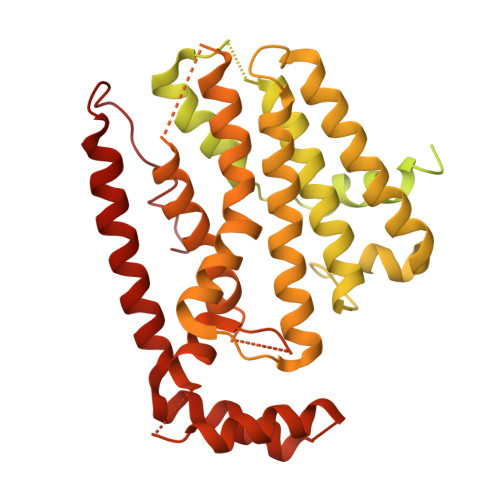
Engineering substrate channeling in a bifunctional terpene synthase.
Wenger, E.S., Schultz, K., Marmorstein, R., Christianson, D.W.(2024) Proc Natl Acad Sci U S A 121: e2408064121-e2408064121
- PubMed: 39365814 Search on PubMedSearch on PubMed Central
- DOI: https://doi.org/10.1073/pnas.2408064121
- Primary Citation Related Structures:
9B3T - PubMed Abstract:
Fusicoccadiene synthase from Phomopsis amygdala (PaFS) is a bifunctional terpene synthase. It contains a prenyltransferase (PT) domain that generates geranylgeranyl diphosphate (GGPP) from dimethylallyl diphosphate and three equivalents of isopentenyl diphosphate, and a cyclase domain that converts GGPP into fusicoccadiene, a precursor of the diterpene glycoside Fusicoccin A. The two catalytic domains are connected by a flexible 69-residue linker. The PT domain mediates oligomerization to form predominantly octamers, with cyclase domains randomly splayed out around the PT core. Surprisingly, despite the random positioning of cyclase domains, substrate channeling is operative in catalysis since most of the GGPP generated by the PT remains on the enzyme for cyclization. Here, we demonstrate that covalent linkage of the PT and cyclase domains is not required for GGPP channeling, although covalent linkage may improve channeling efficiency. Moreover, GGPP competition experiments with other diterpene cyclases indicate that the PaFS PT and cyclase domains are preferential partners regardless of whether they are covalently linked or not. The cryoelectron microscopy structure of the 600-kD "linkerless" construct, in which the 69-residue linker is spliced out and replaced with the tripeptide PTQ, reveals that cyclase pairs associate with all four sides of the PT octamer and exhibit fascinating quaternary structural flexibility. These results suggest that optimal substrate channeling is achieved when a cyclase domain associates with the side of the PT octamer, regardless of whether the two domains are covalently linked and regardless of whether this interaction is transient or locked in place.
- Roy and Diana Vagelos Laboratories, Department of Chemistry, University of Pennsylvania, Philadelphia, PA 19104-6323.
Organizational Affiliation: