Download Mendeley
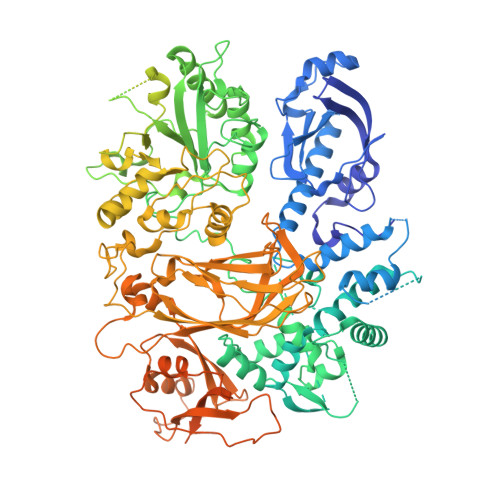
Cryo-EM structure of phospholipase C epsilon defines N-terminal domains and their roles in activity.
Samassekou, K., Garland-Kuntz, E.E., Ohri, V., Fisher, I.J., Erramilli, S.K., Muralidharan, K., Bogdan, L.M., Gick, A.M., Kossiakoff, A., Lyon, A.M.(2025) Commun Biol 8: 1429-1429
- PubMed: 41053213 Search on PubMedSearch on PubMed Central
- DOI: https://doi.org/10.1038/s42003-025-08831-0
- Primary Citation Related Structures:
9B13 - PubMed Abstract:
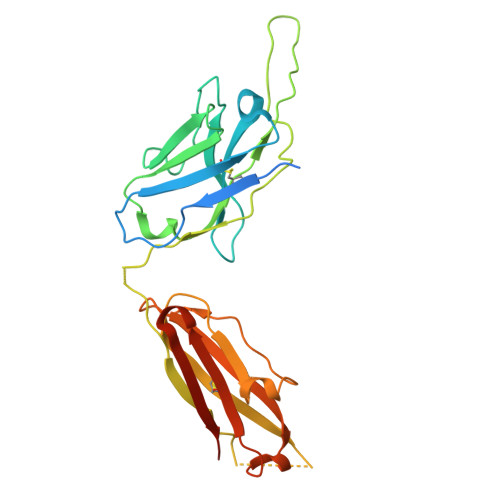
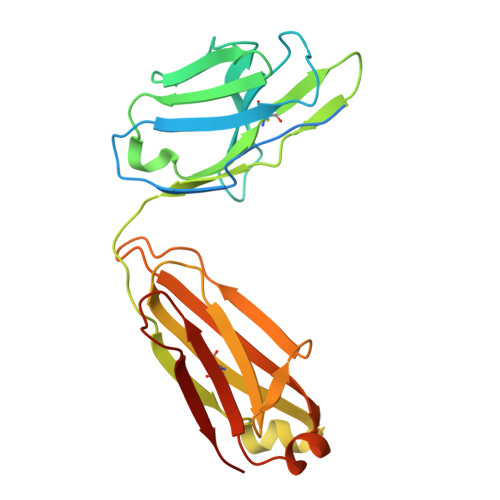
Phospholipase Cε (PLCε) increases intracellular Ca 2+ and protein kinase C (PKC) activity in the cardiovascular system in response to stimulation of G protein coupled receptors (GPCRs) and receptor tyrosine kinases (RTKs). The ability of PLCε to respond to these diverse inputs is due, in part, to multiple, conformationally dynamic regulatory domains. However, this heterogeneity has limited structural studies of the lipase to either individual domains or its catalytic core. Here, we report the 3.9 Å reconstruction of the largest fragment of PLCε to date in complex with an antigen binding fragment (Fab). The structure reveals that PLCε contains a pleckstrin homology (PH) domain and four tandem EF hands, including subfamily-specific insertions and intramolecular interactions with the catalytic core. The structure, together with a model of the holoenzyme, suggest that part of the N-terminus and PH domain may form a surface that supports lipase activity. Functional characterization of this surface confirms it is critical for maximum basal and G protein-stimulated activities. This study provides new insights into the autoinhibited, basal conformation of PLCε and how the N-terminal domains contribute to activity.
- James Tarpo Jr. and Margaret Tarpo Department of Chemistry, Purdue University, West Lafayette, IN, USA.
Organizational Affiliation: