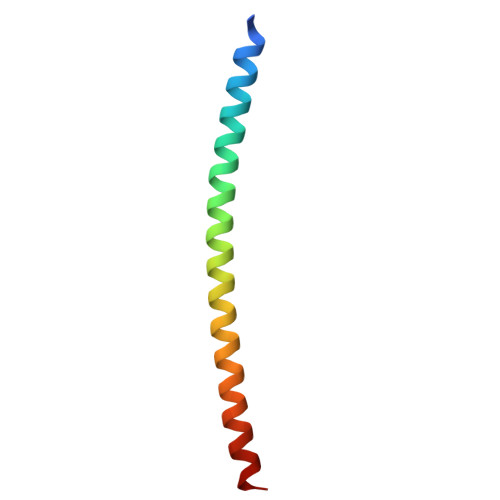
9AVN | pdb_00009avn

Crystal Structure of CARD9 coiled-coil K156-K214 bound to Compound 1


Experimental Data Snapshot

  • Method: X-RAY DIFFRACTION
  • Resolution: 2.73 Å
  • R-Value Free: 
    0.299 (Depositor), 0.315 (DCC) 
  • R-Value Work: 
    0.274 (Depositor), 0.289 (DCC) 
  • R-Value Observed: 
    0.276 (Depositor) 

Starting Model: in silico
View more details

wwPDB Validation 3D Report Full Report

Validation slider image for 9AVN

Ligand Structure Quality Assessment 


This is version 1.1 of the entry. See complete history

Literature

Human genetics guides the discovery of CARD9 inhibitors with anti-inflammatory activity.

Rush, J.S.Wertheimer, J.D.Goldberg, S.D.Raymond, D.Szuchnicki, M.Baltus, A.J.Branson, J.Stratton, C.F.Patrick, A.N.Steele, R.Adhikary, S.Del Rosario, A.Liu, A.Gomersall, N.J.Chung, M.Ranaghan, M.J.Gu, X.Brandt, M.Cao, Z.Bebenek, A.Oliver, B.A.Hoebe, K.Szewczuk, L.M.Venable, J.D.Graham, D.B.Towne, J.Xavier, R.J.

(2026) Cell 189: 1356-1370.e26

  • DOI: https://doi.org/10.1016/j.cell.2025.12.013
  • Primary Citation Related Structures: 
    9AVM, 9AVN

  • PubMed Abstract: 

    Human genetic association studies highlight key genes involved in disease pathology, yet targets identified by these analyses often fall outside the traditional definitions of druggability. A rare truncated variant of the scaffold protein CARD9 is linked with protection from Crohn's disease, prompting us to pursue the development of inhibitors that might similarly modulate innate inflammatory responses. Using a phased approach, we first identified a ligandable site on CARD9 using a structurally diverse DNA-encoded library and defined this site in detail through X-ray crystallography. Building upon this, a subsequent ligand displacement screen identified additional molecules that uniquely engage CARD9 and prevent its assembly into scaffolds needed to nucleate a signalosome for downstream nuclear factor κB (NF-κB) induction. These inhibitors suppressed inflammatory cytokine production in dendritic cells and a humanized CARD9 mouse model. Collectively, this study illustrates a strategy for leveraging protective human genetic variants and chemical biology to tackle challenging targets for dampening inflammation.


  • Organizational Affiliation
    • Center for the Development of Therapeutics, Broad Institute of MIT and Harvard, Cambridge, MA 02142, USA.

Macromolecule Content 

  • Total Structure Weight: 58.28 kDa 
  • Atom Count: 3,713 
  • Modeled Residue Count: 440 
  • Deposited Residue Count: 480 
  • Unique protein chains: 1

Macromolecules

Find similar proteins by:|  3D Structure
Entity ID: 1
MoleculeChains  Sequence LengthOrganismDetailsImage
Caspase recruitment domain-containing protein 9
A, B, C, D, E
A, B, C, D, E, F, G, H
60Homo sapiensMutation(s): 0 
Gene Names: CARD9
UniProt & NIH Common Fund Data Resources
Find proteins for Q9H257 (Homo sapiens)
Explore Q9H257 
Go to UniProtKB:  Q9H257
PHAROS:  Q9H257
GTEx:  ENSG00000187796 
Entity Groups
Sequence Clusters30% Identity50% Identity70% Identity90% Identity95% Identity100% Identity
UniProt GroupQ9H257
Sequence Annotations
Expand
Reference Sequence

Small Molecules

Ligands 1 Unique
IDChains Name / Formula / InChI Key2D Diagram3D Interactions
A1AG7
(Subject of Investigation/LOI)

Query on A1AG7


Download:Ideal Coordinates CCD File
I [auth A],
J [auth D]
(2P)-2-(1-benzyl-3-phenyl-1H-pyrazol-4-yl)-5-chloro-1-[(1R)-1-cyclohexyl-2-(methylamino)-2-oxoethyl]-1H-1,3-benzimidazole-6-carboxylic acid
C33 H32 Cl N5 O3
FZXOIQUTLQABCO-SSEXGKCCSA-N

Experimental Data & Validation

Experimental Data

  • Method: X-RAY DIFFRACTION
  • Resolution: 2.73 Å
  • R-Value Free:  0.299 (Depositor), 0.315 (DCC) 
  • R-Value Work:  0.274 (Depositor), 0.289 (DCC) 
  • R-Value Observed: 0.276 (Depositor) 
Space Group: P 1 21 1
Unit Cell:
Length ( Å )Angle ( ˚ )
a = 56.39α = 90
b = 56.05β = 97.75
c = 84.3γ = 90
Software Package:
Software NamePurpose
BUSTERrefinement
XSCALEdata scaling
PHASERphasing
XDSdata reduction

Structure Validation

View Full Validation Report


Ligand Structure Quality Assessment 


Entry History 

& Funding Information

Deposition Data


Funding OrganizationLocationGrant Number
Other government--

Revision History  (Full details and data files)

  • Version 1.0: 2025-03-12
    Type: Initial release
  • Version 1.1: 2026-04-29
    Changes: Database references