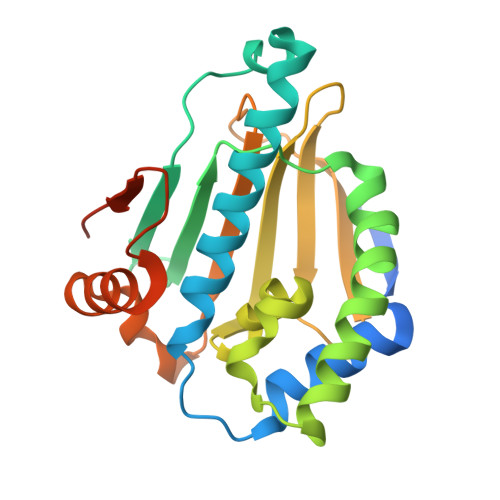
9AUU | pdb_00009auu

Hsp90 NTD in complex with compound 6


Experimental Data Snapshot

  • Method: X-RAY DIFFRACTION
  • Resolution: 2.00 Å
  • R-Value Free: 
    0.222 (Depositor), 0.224 (DCC) 
  • R-Value Work: 
    0.224 (Depositor), 0.225 (DCC) 
  • R-Value Observed: 
    0.224 (Depositor) 

Starting Model: experimental
View more details

wwPDB Validation   3D Report Full Report


Ligand Structure Quality Assessment 


This is version 1.1 of the entry. See complete history


Literature

Aminomethyl Salicylaldehydes Lock onto a Surface Lysine by Forming an Extended Intramolecular Hydrogen Bond Network.

Weaver, J.Craven, G.B.Tram, L.Chen, H.Taunton, J.

(2024) J Am Chem Soc 146: 24233-24237

  • DOI: https://doi.org/10.1021/jacs.4c04314
  • Primary Citation of Related Structures:  
    9AUU

  • PubMed Abstract: 

    The development of electrophilic ligands that rapidly modify specific lysine residues remains a major challenge. Salicylaldehyde-based inhibitors have been reported to form stable imine adducts with the catalytic lysine of protein kinases. However, the targeted lysine in these examples is buried in a hydrophobic environment. A key unanswered question is whether this strategy can be applied to a lysine on the surface of a protein, where rapid hydrolysis of the resulting salicylaldimine is more likely. Here, we describe a series of aminomethyl-substituted salicylaldehydes that target a fully solvated lysine on the surface of the ATPase domain of Hsp90. By systematically varying the orientation of the salicylaldehyde, we discovered ligands with long residence times, the best of which engages Hsp90 in a quasi-irreversible manner. Crystallographic analysis revealed a daisy-chain network of intramolecular hydrogen bonds in which the salicylaldimine is locked into position by the adjacent piperidine linker. This study highlights the potential of aminomethyl salicylaldehydes to generate conformationally stabilized, hydrolysis-resistant imines, even when the targeted lysine is far from the ligand binding site and is exposed to bulk solvent.


  • Organizational Affiliation
    • Chemistry and Chemical Biology Program, University of California─San Francisco, San Francisco, California 94143, United States.

Macromolecules
Find similar proteins by:  (by identity cutoff)  |  3D Structure
Entity ID: 1
MoleculeChains Sequence LengthOrganismDetailsImage
Heat shock protein HSP 90-alpha236Homo sapiensMutation(s): 0 
Gene Names: HSP90AA1HSP90AHSPC1HSPCA
EC: 3.6.4.10
UniProt & NIH Common Fund Data Resources
Find proteins for P07900 (Homo sapiens)
Explore P07900 
Go to UniProtKB:  P07900
PHAROS:  P07900
GTEx:  ENSG00000080824 
Entity Groups  
Sequence Clusters30% Identity50% Identity70% Identity90% Identity95% Identity100% Identity
UniProt GroupP07900
Sequence Annotations
Expand
  • Reference Sequence
Small Molecules
Ligands 2 Unique
IDChains Name / Formula / InChI Key2D Diagram3D Interactions
A1AG2 (Subject of Investigation/LOI)
Query on A1AG2

Download Ideal Coordinates CCD File 
B [auth A]3-{[(3R)-3-({6-amino-8-[(6-iodo-2H-1,3-benzodioxol-5-yl)sulfanyl]-9H-purin-9-yl}methyl)piperidin-1-yl]methyl}-6-fluoro-2-hydroxybenzaldehyde
C26 H24 F I N6 O4 S
KTMOYNRHBABLKL-AWEZNQCLSA-N
MG
Query on MG

Download Ideal Coordinates CCD File 
C [auth A]MAGNESIUM ION
Mg
JLVVSXFLKOJNIY-UHFFFAOYSA-N
Experimental Data & Validation

Experimental Data

  • Method: X-RAY DIFFRACTION
  • Resolution: 2.00 Å
  • R-Value Free:  0.222 (Depositor), 0.224 (DCC) 
  • R-Value Work:  0.224 (Depositor), 0.225 (DCC) 
  • R-Value Observed: 0.224 (Depositor) 
Space Group: I 2 2 2
Unit Cell:
Length ( Å )Angle ( ˚ )
a = 66.878α = 90
b = 91.817β = 90
c = 98.481γ = 90
Software Package:
Software NamePurpose
PHENIXrefinement
Aimlessdata scaling
PHASERphasing
XDSdata reduction

Structure Validation

View Full Validation Report


Ligand Structure Quality Assessment 


Entry History & Funding Information

Deposition Data


Funding OrganizationLocationGrant Number
Other privateUnited States--

Revision History  (Full details and data files)

  • Version 1.0: 2024-10-16
    Type: Initial release
  • Version 1.1: 2024-10-23
    Changes: Database references