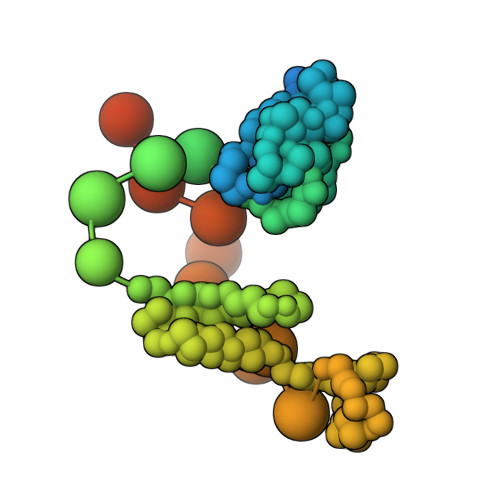
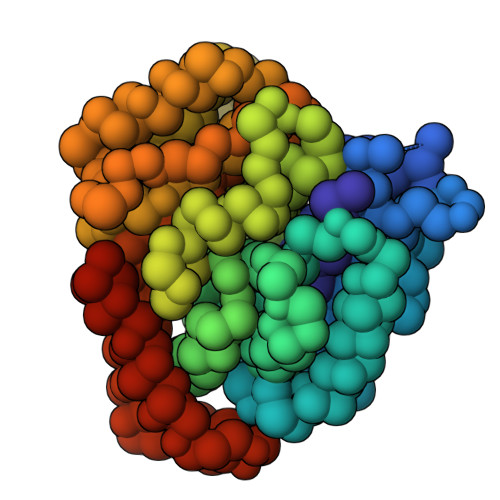
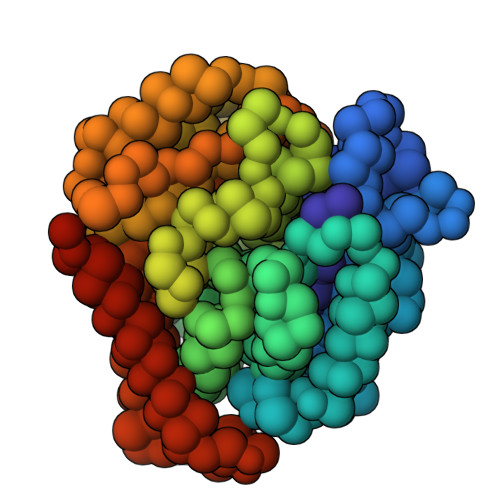
9A10 | pdb_00009a10

Modeling of the interaction between doublecortin and microtubule, NDCs fixed at lateral orientation

Integrative structure models are generated using different types of input information, including varied experimental data, physical principles, statistical preferences, and other prior information.


Integrative Structure Snapshot

  • Multi-Scale: Yes 
  • Multi-State: No 
  • Ordered-State: No 
  • Deposited Models: 1 
  • Representative Model: 1 

This is version 1.0 of the entry. See complete history


Literature

Doublecortin engages the microtubule lattice through a cooperative binding mode involving its C-terminal domain

Rafiei ALee LCrowder ASaltzberg DSali ABrouhard GSchreimer DC

(2022) Elife 11: e66975

  • DOI: https://doi.org/10.7554/eLife.66975
  • Primary Citation of Related Structures:  
    9A0Z, 9A10, 9A11, 9A12

  • PubMed Abstract: 

    Doublecortin (DCX) is a microtubule (MT)-associated protein that regulates MT structure and function during neuronal development and mutations in DCX lead to a spectrum of neurological disorders. The structural properties of MT-bound DCX that explain these disorders are incompletely determined. Here, we describe the molecular architecture of the DCX-MT complex through an integrative modeling approach that combines data from X-ray crystallography, cryo-electron microscopy, and a high-fidelity chemical crosslinking method. We demonstrate that DCX interacts with MTs through its N-terminal domain and induces a lattice-dependent self-association involving the C-terminal structured domain and its disordered tail, in a conformation that favors an open, domain-swapped state. The networked state can accommodate multiple different attachment points on the MT lattice, all of which orient the C-terminal tails away from the lattice. As numerous disease mutations cluster in the C-terminus, and regulatory phosphorylations cluster in its tail, our study shows that lattice-driven self-assembly is an important property of DCX.


  • Organizational Affiliation
    • Department of Chemistry, University of Calgary, Calgary, Canada.

Macromolecules
Find similar proteins by:  (by identity cutoff) 
|   3D Structure  
Entity ID: 1
MoleculeChains Sequence LengthOrganismDetailsImage
Doublecortin
A, B
365Homo sapiensMutation(s): 0 
UniProt & NIH Common Fund Data Resources
Find proteins for O43602 (Homo sapiens)
Explore O43602 
Go to UniProtKB:  O43602
PHAROS:  O43602
GTEx:  ENSG00000077279 
Entity Groups  
Sequence Clusters30% Identity50% Identity70% Identity90% Identity95% Identity100% Identity
UniProt GroupO43602
Sequence Annotations
Expand
  • Reference Sequence
Find similar proteins by:  (by identity cutoff) 
|   3D Structure  
Entity ID: 2
MoleculeChains Sequence LengthOrganismDetailsImage
Alpha-Tubulin
C, D, E, F, G
C, D, E, F, G, H, I, J, K, L, M, N
451Sus scrofaMutation(s): 0 
Gene Names: TUBA1B
EC: 3.6.5
UniProt
Find proteins for Q2XVP4 (Sus scrofa)
Explore Q2XVP4 
Go to UniProtKB:  Q2XVP4
Entity Groups  
Sequence Clusters30% Identity50% Identity70% Identity90% Identity95% Identity100% Identity
UniProt GroupQ2XVP4
Sequence Annotations
Expand
  • Reference Sequence
Find similar proteins by:  (by identity cutoff) 
|   3D Structure  
Entity ID: 3
MoleculeChains Sequence LengthOrganismDetailsImage
Beta-Tubulin
O, P, Q, R, S
O, P, Q, R, S, T, U, V, W, X, Y, Z
445Sus scrofaMutation(s): 0 
UniProt
Find proteins for P02554 (Sus scrofa)
Explore P02554 
Go to UniProtKB:  P02554
Entity Groups  
Sequence Clusters30% Identity50% Identity70% Identity90% Identity95% Identity100% Identity
UniProt GroupP02554
Sequence Annotations
Expand
  • Reference Sequence
Experimental Data & Validation

Integrative Structure Snapshot

  • Multi-Scale: Yes 
  • Multi-State: No 
  • Ordered-State: No 
  • Deposited Models: 1 
  • Representative Model: 1 

Structure Validation

View Full Validation Report

View Summary Validation Report


Entry History 

Deposition Data

Revision History  (Full details and data files)

  • Version 1.0: 2022-05-13
    Type: Initial release