Download Mendeley
Structural requirements of KAI2 ligands for activation of signal transduction.
Kushihara, R., Nakamura, A., Takegami, K., Seto, Y., Kato, Y., Dohra, H., Ohnishi, T., Todoroki, Y., Takeuchi, J.(2025) Proc Natl Acad Sci U S A 122: e2414779122-e2414779122
- PubMed: 39977316 Search on PubMedSearch on PubMed Central
- DOI: https://doi.org/10.1073/pnas.2414779122
- Primary Citation Related Structures:
8ZVN, 8ZVO - PubMed Abstract:
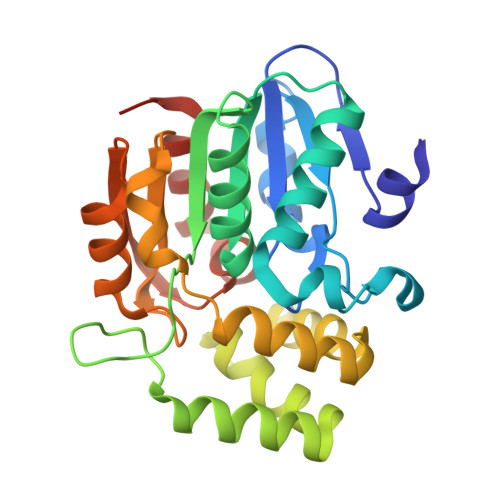
Karrikin Insensitive 2 (KAI2), identified as the receptor protein for karrikins (KARs), which are smoke-derived seed germination stimulants, belongs to the same α/β-hydrolase family as D14, the receptor for strigolactones (SLs). KAI2 is believed to recognize an endogenous butenolide (KAI2 ligand; KL), but the identity of this compound remains unknown. Recent studies have suggested that ligand hydrolysis by KAI2 is a prerequisite for receptor activation to induce interaction with the target proteins, similar to the situation with D14. However, direct experimental evidence has been lacking. Here, we designed KAI2 ligands (carba-dMGers) whose butenolide rings were modified so that they cannot be hydrolyzed or dissociated from the original ligand molecule by KAI2, by structurally modifying dMGer, a potent and selective KAI2 agonist. Using these dMGer analogs, we found that the strongly bioactive ligand, (+)-dMGer, was hydrolyzed by KAI2 at a lower enzymatic rate compared with the weakly bioactive ligand, (+)-1'-carba-dMGer, and the hydrolyzed butenolide ring of (+)-dMGer was transiently trapped in the catalytic pocket of KAI2. Additionally, structural analysis revealed that (+)-6'-carba-dMGer bound to the catalytic pocket of KAI2 in the unhydrolyzed state. However, this binding did not induce the interaction between KAI2 and SMAX1, indicating that ligand binding to the receptor alone was not sufficient for KAI2 signaling. This study showed experimental data from a ligand structure-activity study that ligand hydrolysis and subsequent covalent adduct formation with the catalytic triad plays a key role in KAI2 activation, providing insight into the chemical structure of the Arabidopsis KL.
- Department of Agriculture, Graduate School of Science and Technology, Shizuoka University, Shizuoka 422-8529, Japan.
Organizational Affiliation: