Download Mendeley
The reduced interaction between SufS and SufU in Mycoplasma penetrans results in diminished sulfotransferase activity.
Ma, D., Yao, H., Liu, Y., Gong, W., Zhao, Y., Wang, R., Wu, C., Wang, W., Wang, H.(2024) Int J Biol Macromol 284: 138181-138181
- PubMed: 39615726 Search on PubMed
- DOI: https://doi.org/10.1016/j.ijbiomac.2024.138181
- Primary Citation Related Structures:
8ZTP, 8ZTQ - PubMed Abstract:
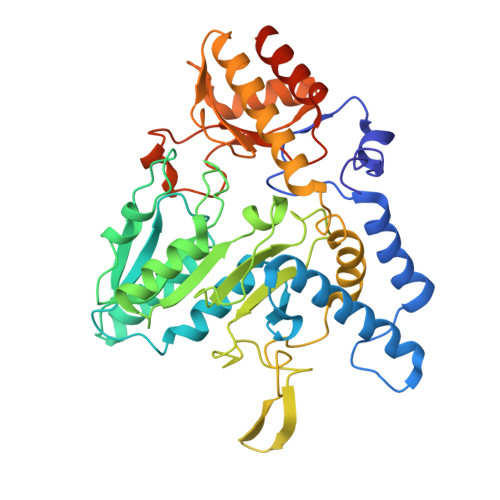
Mycoplasma Penetrans (Mpe) is an AIDS-related mycoplasma that is also closely related to respiratory diseases. Proteins involved in the first phase of Fe-S cluster biosynthesis in the SUF-like pathway are essential in Gram-positive bacteria because there is no redundant Fe-S cluster biosynthetic pathway in these proteins. In this study, we characterized two essential proteins: cysteine desulphurase (MpeSufS) and sulfurtransferase (MpeSufU) in Mpe, and resolved their crystal structures. Our results reveal that MpeSufS belongs to type II cysteine desulfurase, and MpeSufU is a Zn 2+ -containing sulfurtransferase. Residue Q342 in MpeSufS and the zinc atom in MpeSufU mediate sulfur transfer from MpeSufS to MpeSufU. Mutation of Q342 significantly impacts the cysteine desulfurase activity. This study provides new insights into the regulation of the activity of the SufS-SufU complex, which will help guide the design of drugs for the treatment of mycoplasma infections.
- Key Laboratory of Chemical Biology and Molecular Engineering of Education Ministry, Key Laboratory of Energy Conversion and Storage Materials of Shanxi Provence, Institute of Molecular Science, Shanxi University, Taiyuan 030006, China.
Organizational Affiliation: