Download Mendeley
Structural and functional characterization of an active site-influencing variant (IMP-1-F218Y) in IMP-1 metallo-beta-lactamase.
Baidya, S., Dhankhar, K., Karan, R., Hazra, M., Adhikary, R., Sen, T., Hazra, S.(2026) FEBS J
- PubMed: 41870155 Search on PubMedSearch on PubMed Central
- DOI: https://doi.org/10.1111/febs.70474
- Primary Citation Related Structures:
8ZTB - PubMed Abstract:
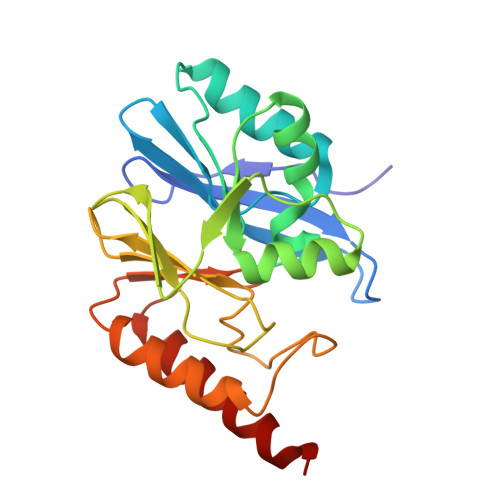
Antimicrobial resistance (AMR) has become a critical global health challenge, largely driven by metallo-β-lactamase (MBL)-mediated hydrolysis of β-lactam antibiotics, which remain the cornerstone of modern antimicrobial therapy. IMP-1, an MBL first identified in Japan, exhibits potent carbapenemase activity and currently lacks effective clinical inhibitors. To explore how distal mutations modulate catalytic behaviour in B1 MBLs, we characterised IMP-1 and its variant IMP-1-F218Y, using biophysical, biochemical, and structural approaches. Circular-dichroism spectra confirmed the preservation of the α-helical MBL fold in both enzymes, while kinetic analyses revealed enhanced hydrolysis by IMP-1-F218Y across most β-lactam substrates. Antimicrobial susceptibility-testing supported this observation, linking the increased catalytic efficiency of the mutant to elevated resistance, except under Zinc(II)-limiting conditions. The crystal structure of IMP-1-F218Y (2.9 Å; PDB ID: 8ZTB) showed an additional Y218-S262 hydrogen bond that reduces the active-site volume and stabilises the L3 loop, positioning W64 flatter across the catalytic cleft. Molecular-dynamics simulations captured this conformational compaction, indicating a more compact and catalytically favourable active site. Unlike natural IMP variants with selective substrate profiles, IMP-1-F218Y displayed an expanded substrate spectrum, demonstrating that a single distal substitution can modulate enzymatic plasticity and broaden catalytic range. These findings provide mechanistic insight into the structural adaptability of B1 MBLs and emphasise the importance of targeting such flexibility in the design of next-generation β-lactamase inhibitors.
- Department of Biosciences and Bioengineering, Indian Institute of Technology, Roorkee, Haridwar, Uttarakhand, India.
Organizational Affiliation: