Download Mendeley
Aspartic acid residues in BBE-like enzymes from Morus alba promote a function shift from oxidative cyclization to dehydrogenation.
Guo, N., Gu, J., Zhou, Q., Liu, F., Dong, H., Ding, Q., Wang, Q., Wu, D., Yang, J., Fan, J., Gao, L., Houk, K.N., Lei, X.(2025) Proc Natl Acad Sci U S A 122: e2504346122-e2504346122
- PubMed: 40828030 Search on PubMedSearch on PubMed Central
- DOI: https://doi.org/10.1073/pnas.2504346122
- Primary Citation Related Structures:
8ZLS, 8ZLT - PubMed Abstract:
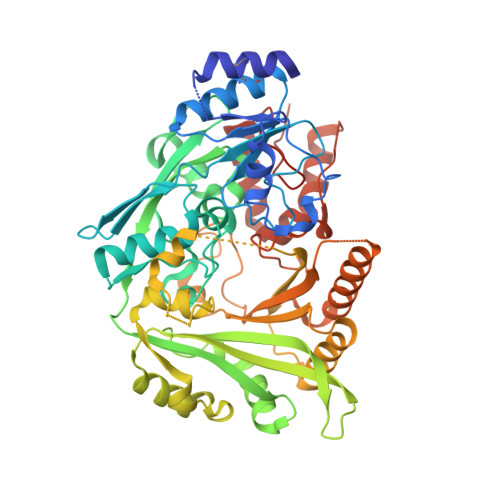
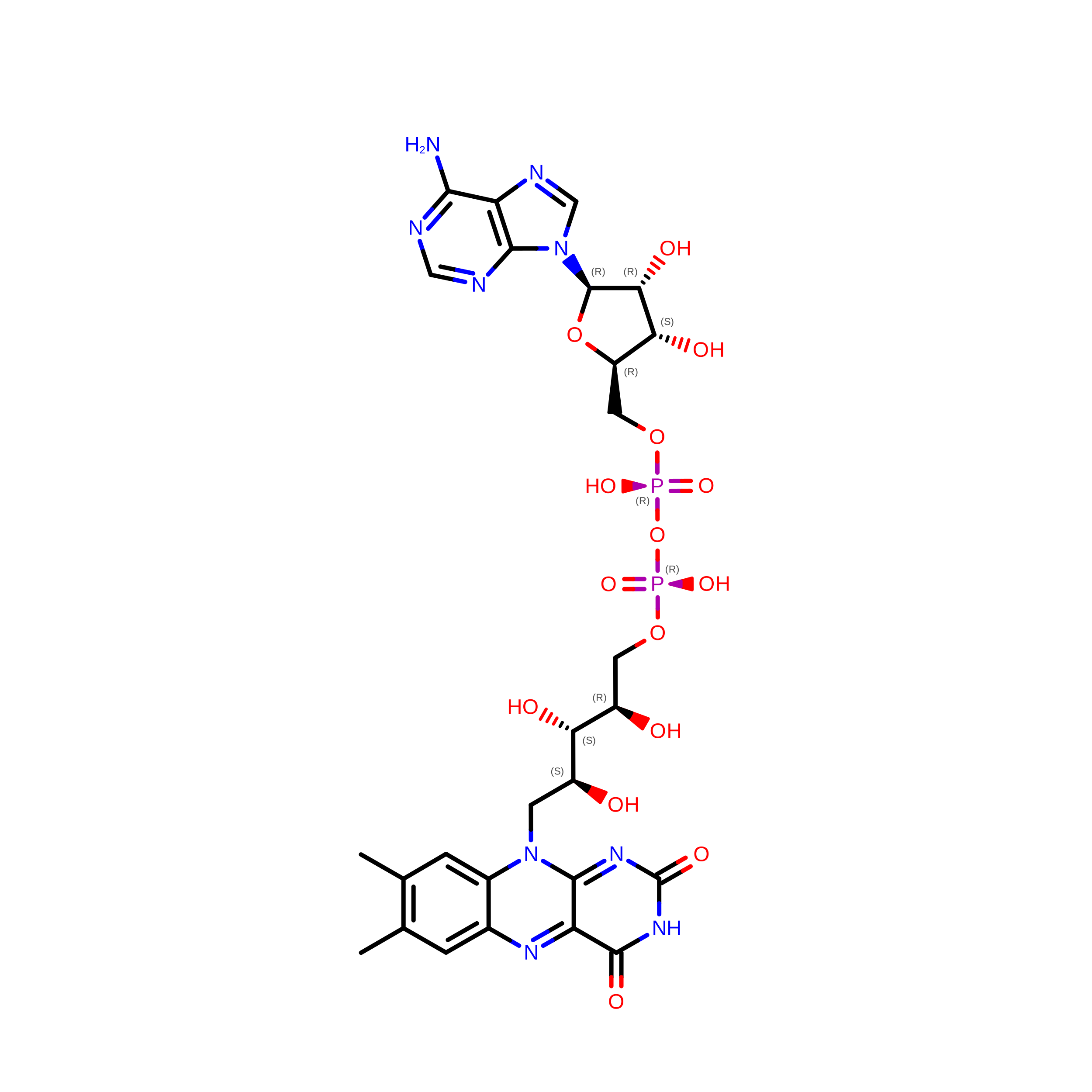
Berberine bridge enzyme (BBE)-like enzymes catalyze various oxidative cyclization and dehydrogenation reactions in natural product biosynthesis, but the molecular mechanism underlying the selectivity remains unknown. Here, we elucidated the catalytic mechanism of BBE-like oxidases from Morus alba involved in the oxidative cyclization and dehydrogenation of moracin C. X-ray crystal structures of a functionally promiscuous flavin adenine dinucleotide (FAD)-bound oxidase, MaDS1, with and without an oxidative dehydrogenation product were determined at 2.03 Å and 2.21 Å resolution, respectively. Structure-guided mutagenesis and sequence analysis have identified a conserved aspartic acid that directs the reaction toward the oxidative dehydrogenation pathway. A combination of density functional theory (DFT) calculations and molecular dynamics (MD) simulations has revealed that aspartic acid acts as the catalytic base to deprotonate the carbon-cation intermediate to generate the dehydrogenated product, which otherwise undergoes a spontaneous 6π electrocyclization in the oxidative cyclization pathway to furnish the 2H-benzopyran product.
- Peking-Tsinghua Center for Life Sciences, Peking University, Beijing 100871, China.
Organizational Affiliation: