8ZHZ | pdb_00008zhz

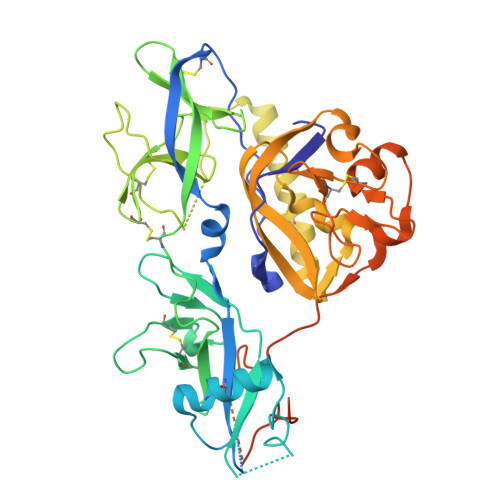
Structure of Ikoma lyssavirus glycoprotein in pre-fusion state


Experimental Data Snapshot

  • Method: X-RAY DIFFRACTION
  • Resolution: 2.88 Å
  • R-Value Free: 
    0.281 (Depositor), 0.285 (DCC) 
  • R-Value Work: 
    0.225 (Depositor), 0.232 (DCC) 
  • R-Value Observed: 
    0.228 (Depositor) 

Starting Model: experimental
View more details

wwPDB Validation 3D Report Full Report

Validation slider image for 8ZHZ

Ligand Structure Quality Assessment 


This is version 1.1 of the entry. See complete history

Literature

Structures of two lyssavirus glycoproteins trapped in pre- and post-fusion states and the implications on the spatial-temporal conformational transition along with pH-decrease.

Yang, F.Lin, S.Yuan, X.Shu, S.Yu, Y.Yang, J.Ye, F.Chen, Z.He, B.Li, J.Zhao, Q.Ye, H.Cao, Y.Lu, G.

(2025) PLoS Pathog 21: e1012923-e1012923

  • DOI: https://doi.org/10.1371/journal.ppat.1012923
  • Primary Citation Related Structures: 
    8ZHW, 8ZHZ

  • PubMed Abstract: 

    Lyssavirus glycoprotein plays a crucial role in mediating virus entry and serves as the major target for neutralizing antibodies. During membrane fusion, the lyssavirus glycoprotein undergoes a series of low-pH-induced conformational transitions. Here, we report the structures of Ikoma lyssavirus and Mokola lyssavirus glycoproteins, with which we believe that we have trapped the proteins in pre-fusion and post-fusion states respectively. By analyzing the available lyssaviral glycoprotein structures, we present a sequential conformation-transition model, in which two structural elements in the glycoprotein undergo fine-modulated secondary structural transitions, changing the glycoprotein from a bended hairpin conformation to an extended linear conformation. In addition, such conformational change is further facilitated, as observed in our surface plasmon resonance assay, by the pH-regulated interactions between the membrane-proximal region and the pleckstrin homology and the fusion domains. The structural features elucidated in this study will facilitate the design of vaccines and anti-viral drugs against lyssaviruses.


  • Organizational Affiliation
    • Department of Emergency Medicine, State Key Laboratory of Biotherapy, West China Hospital, Sichuan University, Chengdu, Sichuan, China.

Macromolecule Content 

  • Total Structure Weight: 303.05 kDa 
  • Atom Count: 17,908 
  • Modeled Residue Count: 2,204 
  • Deposited Residue Count: 2,640 
  • Unique protein chains: 1

Macromolecules

Find similar proteins by:|  3D Structure
Entity ID: 1
MoleculeChains  Sequence LengthOrganismDetailsImage
Glycoprotein
A, B, C, D, E
A, B, C, D, E, F
440Ikoma lyssavirusMutation(s): 0 
UniProt
Find proteins for J7JVS8 (Ikoma lyssavirus)
Explore J7JVS8 
Go to UniProtKB:  J7JVS8
Entity Groups
Sequence Clusters30% Identity50% Identity70% Identity90% Identity95% Identity100% Identity
UniProt GroupJ7JVS8
Glycosylation
Glycosylation Sites: 2
Sequence Annotations
Expand
Reference Sequence

Oligosaccharides

Help  
Entity ID: 2
MoleculeChains Length2D Diagram GlycosylationD Interactions
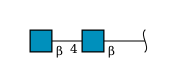
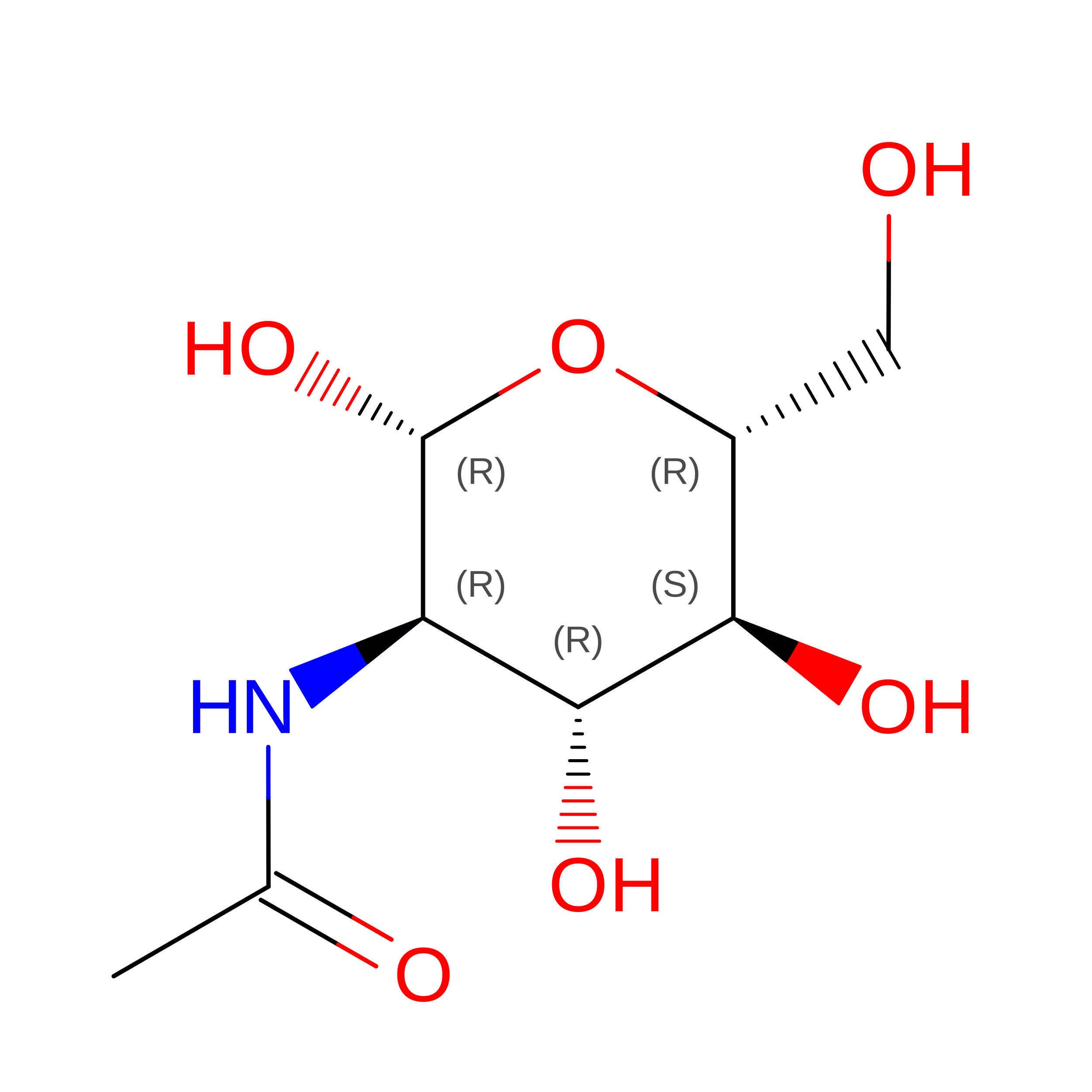
2-acetamido-2-deoxy-beta-D-glucopyranose-(1-4)-2-acetamido-2-deoxy-beta-D-glucopyranose
G, H, I
2N-Glycosylation
Glycosylation Resources
GlyTouCan: G42666HT
GlyCosmos: G42666HT
GlyGen: G42666HT

Experimental Data & Validation

Experimental Data

  • Method: X-RAY DIFFRACTION
  • Resolution: 2.88 Å
  • R-Value Free:  0.281 (Depositor), 0.285 (DCC) 
  • R-Value Work:  0.225 (Depositor), 0.232 (DCC) 
  • R-Value Observed: 0.228 (Depositor) 
Space Group: P 1 21 1
Unit Cell:
Length ( Å )Angle ( ˚ )
a = 122.915α = 90
b = 90.746β = 90.08
c = 151.311γ = 90
Software Package:
Software NamePurpose
PHENIXrefinement
HKL-2000data reduction
HKL-2000data scaling
PHASERphasing

Structure Validation

View Full Validation Report


Ligand Structure Quality Assessment 


Entry History 

& Funding Information

Deposition Data


Funding OrganizationLocationGrant Number
Not funded--

Revision History  (Full details and data files)

  • Version 1.0: 2025-02-05
    Type: Initial release
  • Version 1.1: 2025-08-20
    Changes: Database references