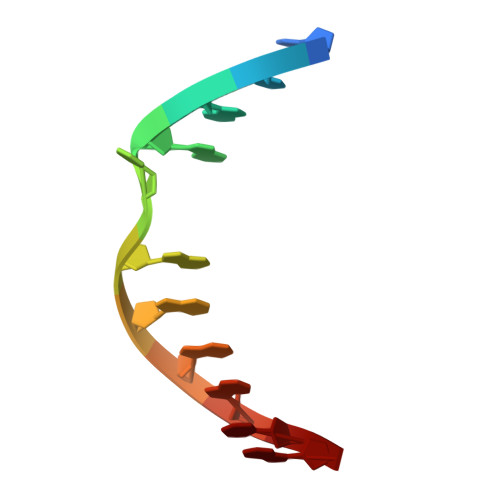
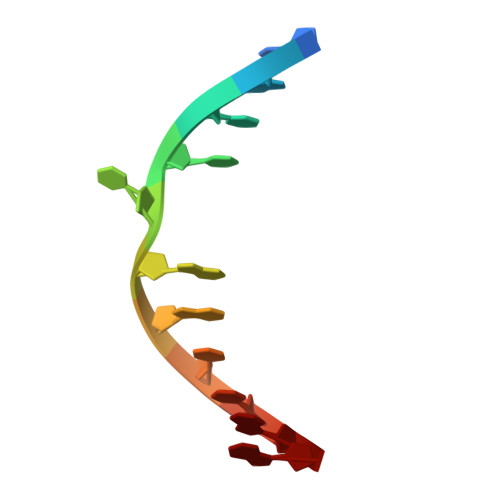
8ZD2 | pdb_00008zd2

NMR structure of the (CGG-dsDNA:ND=) 1:2 complex


Experimental Data Snapshot

  • Method: SOLUTION NMR
  • Conformers Calculated: 150 
  • Conformers Submitted: 30 
  • Selection Criteria: structures with the lowest energy 

wwPDB Validation   3D Report Full Report

Currently 8ZD2 does not have a validation slider image.


This is version 2.0 of the entry. See complete history


Literature

NMR-Based Rational Drug Design of G:G Mismatch DNA Binding Ligand Trapping Transient Complex via Disruption of a Key Allosteric Interaction.

Sakurabayashi, S.Furuita, K.Yamada, T.Sugiura, N.Nomura, M.Nakane, T.Kawamoto, A.Kurisu, G.Miyanoiri, Y.Fujiwara, T.Nakatani, K.Kojima, C.

(2025) J Am Chem Soc 147: 14254-14269

  • DOI: https://doi.org/10.1021/jacs.4c17538
  • Primary Citation of Related Structures:  
    8ZD2, 8ZD7, 8ZD8

  • PubMed Abstract: 

    Small molecules that bind to mismatched DNA have been applied in various fields, including nanotechnology, bioimaging, and therapeutics. However, the intrinsic dynamic nature of mismatched DNA complicates the prediction of structural changes upon ligand binding, hindering rational ligand design. In this study, NMR was used for structure-based drug design, with a focus on the G:G mismatch binder ND and the structural dynamics of the DNA- ND complex. Through comprehensive NMR analysis with isotope labeling, two complex structures, the transient and stable complexes, were successfully determined. The nucleobase flip-outs and the distortion of the phosphate backbone of the complex structures were characterized by residual dipolar coupling (RDC) and 31 P NMR, respectively. The RDC-refined stable complex structure suggested that the ligand linker-nucleobase interaction allosterically regulates a structural transition. This interaction was experimentally validated by 1 H- 15 N HSQC spectra using a 15 N-labeled ligand. Disruption of this key allosteric interaction facilitated the design of a new ligand, sND , that traps the transient complex structure. In conclusion, comprehensive NMR analysis using a weak binder aids in designing nucleic acid-binding ligands based on transient complex structures.


  • Organizational Affiliation
    • Department of Regulatory Bioorganic Chemistry, The Institute of Scientific and Industrial Research (SANKEN), Osaka University, 8-1 Mihogaoka, Osaka, Ibaraki 567-0047, Japan.

Macromolecules

Find similar nucleic acids by:  Sequence   |   3D Structure  

Entity ID: 1
MoleculeChains LengthOrganismImage
DNA (5'-D(*CP*TP*AP*AP*CP*GP*GP*AP*AP*TP*G)-3')A [auth 1]11Homo sapiens
Sequence Annotations
Expand
  • Reference Sequence

Find similar nucleic acids by:  Sequence   |   3D Structure  

Entity ID: 2
MoleculeChains LengthOrganismImage
DNA (5'-D(*CP*AP*TP*TP*CP*GP*GP*TP*TP*AP*G)-3')B [auth 2]11Homo sapiens
Sequence Annotations
Expand
  • Reference Sequence
Small Molecules
Ligands 1 Unique
IDChains Name / Formula / InChI Key2D Diagram3D Interactions
A1L1S (Subject of Investigation/LOI)
Query on A1L1S

Download Ideal Coordinates CCD File 
C [auth 1],
D [auth 2]
~{N}-(7-methyl-1,8-naphthyridin-2-yl)-3-[[3-[(7-methyl-1,8-naphthyridin-2-yl)amino]-3-oxidanylidene-propyl]amino]propanamide
C24 H25 N7 O2
QZBZQIYEBGGLJT-UHFFFAOYSA-N
Experimental Data & Validation

Experimental Data

  • Method: SOLUTION NMR
  • Conformers Calculated: 150 
  • Conformers Submitted: 30 
  • Selection Criteria: structures with the lowest energy 

Structure Validation

View Full Validation Report

Currently 8ZD2 does not have a validation slider image.


Entry History & Funding Information

Deposition Data


Funding OrganizationLocationGrant Number
Japan Society for the Promotion of Science (JSPS)JapanJP22H05536
Japan Society for the Promotion of Science (JSPS)JapanJP23J02416
Japan Agency for Medical Research and Development (AMED)JapanJP23ama121001
Japan Science and TechnologyJapanJPMJFS2125
Japan Society for the Promotion of Science (JSPS)JapanJP21K06047

Revision History  (Full details and data files)

  • Version 1.0: 2025-04-30
    Type: Initial release
  • Version 2.0: 2025-11-12
    Changes: Atomic model, Database references, Derived calculations