Download Mendeley
Targeting SARS-CoV-2 main protease for the discovery of a broad-spectrum COVID-19 inhibitor by intensive multi-tiered validation.
Zhang, M., Wang, C., Feng, L., Yang, Q., Cao, Y., Zhao, Y., Zhang, J., Wang, Y., Rao, Z., Zhang, B.(2025) Acta Pharm Sin B 15: 5789-5802
- PubMed: 41311409 Search on PubMedSearch on PubMed Central
- DOI: https://doi.org/10.1016/j.apsb.2025.09.033
- Primary Citation Related Structures:
8ZBP - PubMed Abstract:
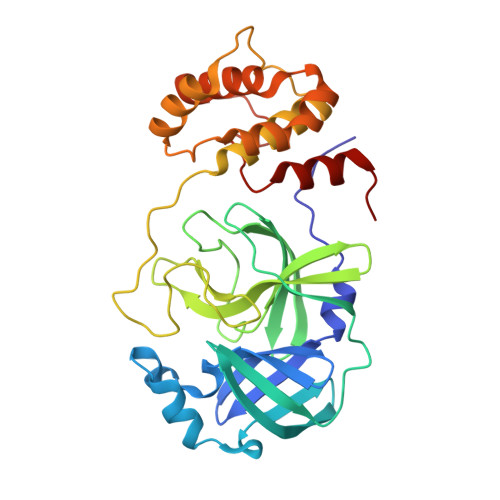
SARS-CoV-2 and its emerging variants continue to pose a significant global public health threat. The SARS-CoV-2 main protease (M pro ) is a critical target for the development of antiviral agents that can inhibit viral replication and transcription. In this study, we identified chebulagic acid (CHLA), isolated from Terminalia chebula Retz., as a potent non-peptidomimetic and non-covalent M pro inhibitor. CHLA exhibited intermolecular interactions and provided significant protection to Vero E6 cells against a range of SARS-CoV-2 variants, including the wild-type, Delta, Omicron BA.1.1, BA.2.3, BA.4, and BA.5, with EC 50 values below 2 μmol/L. Moreover, in vivo studies confirmed the antiviral efficacy of CHLA in K18-hACE2 mice. Notably, CHLA bound to a unique groove at the interface between M pro domains I and II, which was revealed by the high-resolution crystal structure (1.4 Å) of the M pro -CHLA complex, shrinking the substrate binding pocket of M pro and inducing M pro aggregation. CHLA was proposed to act as an allosteric inhibitor. Pharmacokinetic profiling and safety assessments underscore CHLA's potential as a promising broad-spectrum antiviral candidate. These findings report a novel binding site on M pro and identify antiviral activity of CHLA, providing a robust framework for lead compounds discovery and elucidating the underlying molecular mechanisms of inhibition.
- State Key Laboratory of Chinese Medicine Modernization, Tianjin University of Traditional Chinese Medicine, Tianjin 301617, China.
Organizational Affiliation: