Download Mendeley
Slow Conformational Exchange between Partially Folded and Near-Native States of Ubiquitin: Evidence for a Multistate Folding Model.
Adhada, S.T., Sarma, S.P.(2024) Biochemistry 63: 2565-2579
- PubMed: 39351677 Search on PubMed
- DOI: https://doi.org/10.1021/acs.biochem.4c00321
- Primary Citation Related Structures:
8YSY, 8YUM - PubMed Abstract:
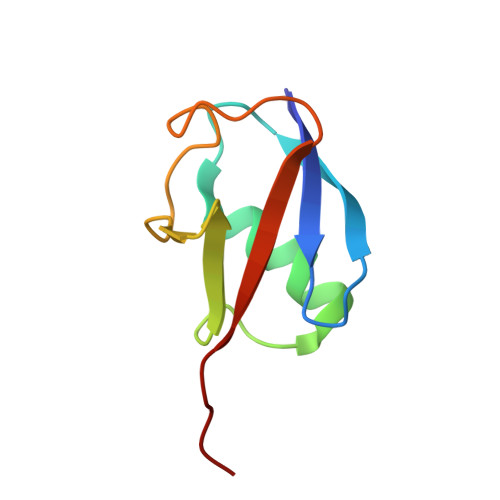
The mechanism by which small proteins fold, i.e., via intermediates or via a two-state mechanism, is a subject of intense investigation. Intermediate states in the folding pathways of these proteins are sparsely populated due to transient lifetimes under normal conditions rendering them transparent to a majority of the biophysical methods employed for structural, thermodynamic, and kinetic characterization, which attributes are essential for understanding the cooperative folding/unfolding of such proteins. Dynamic NMR spectroscopy has enabled the characterization of folding intermediates of ubiquitin that exist in equilibrium under conditions of low pH and denaturants. At low pH, an unlocked state defined as N' is in fast exchange with an invisible state, U″, as observed by CEST NMR. Addition of urea to ubiquitin at pH 2 creates two new states F ' and U ' , which are in slow exchange ( k F'→U' = 0.14 and k U'→F' = 0.28 s -1 ) as indicated by longitudinal ZZ-magnetization exchange spectroscopy. High-resolution solution NMR structures of F ' show it to be in an "unlocked" conformation with measurable changes in rotational diffusion, translational diffusion, and rotational correlational times. U ' is characterized by the presence of just the highly conserved N-terminal β1-β2 hairpin. The folding of ubiquitin is cooperative and is nucleated by the formation of an N-terminal β-hairpin followed by significant hydrophobic collapse of the protein core resulting in the formation of bulk of the secondary structural elements stabilized by extensive tertiary contacts. U ' and F ' may thus be described as early and late folding intermediates in the ubiquitin folding pathway.
- Molecular Biophysics Unit, Indian Institute of Science, Bengaluru, Karnataka 560012, India.
Organizational Affiliation: