Download Mendeley
Crystal structure and nucleic acid binding mode of CPV NSP9: implications for viroplasm in Reovirales.
Wang, Y., Guo, H., Lu, Y., Yang, W., Li, T., Ji, X.(2024) Nucleic Acids Res 52: 11115-11127
- PubMed: 39287123 Search on PubMedSearch on PubMed Central
- DOI: https://doi.org/10.1093/nar/gkae803
- Primary Citation Related Structures:
8Y9K - PubMed Abstract:
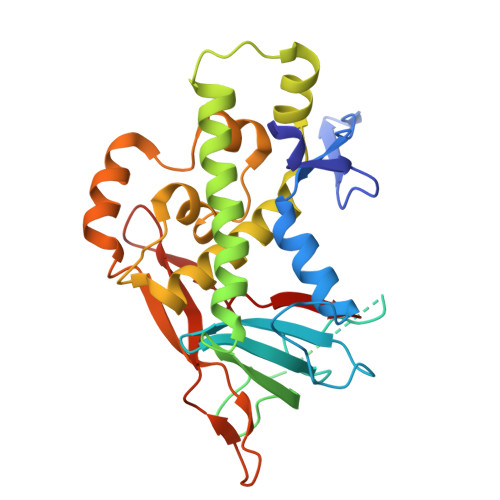
Cytoplasmic polyhedrosis viruses (CPVs), like other members of the order Reovirales, produce viroplasms, hubs of viral assembly that shield them from host immunity. Our study investigates the potential role of NSP9, a nucleic acid-binding non-structural protein encoded by CPVs, in viroplasm biogenesis. We determined the crystal structure of the NSP9 core (NSP9ΔC), which shows a dimeric organization topologically similar to the P9-1 homodimers of plant reoviruses. The disordered C-terminal region of NSP9 facilitates oligomerization but is dispensable for nucleic acid binding. NSP9 robustly binds to single- and double-stranded nucleic acids, regardless of RNA or DNA origin. Mutagenesis studies further confirmed that the dimeric form of NSP9 is critical for nucleic acid binding due to positively charged residues that form a tunnel during homodimerization. Gel migration assays reveal a unique nucleic acid binding pattern, with the sequential appearance of two distinct complexes dependent on protein concentration. The similar gel migration pattern shared by NSP9 and rotavirus NSP3, coupled with its structural resemblance to P9-1, hints at a potential role in translational regulation or viral genome packaging, which may be linked to viroplasm. This study advances our understanding of viroplasm biogenesis and Reovirales replication, providing insights into potential antiviral drug targets.
- Department of Infectious Diseases, Nanjing Drum Tower Hospital, State Key Laboratory of Pharmaceutical Biotechnology, School of Life Sciences, Institute of Viruses and Infectious Diseases, Chemistry and Biomedicine Innovation Center (ChemBIC), Institute of Artificial Intelligence Biomedicine, Nanjing University, Nanjing, China.
Organizational Affiliation: