Download Mendeley
Structural insights into the inhibition mechanism of fungal GWT1 by manogepix.
Dai, X., Liu, X., Li, J., Chen, H., Yan, C., Li, Y., Liu, H., Deng, D., Wang, X.(2024) Nat Commun 15: 9194-9194
- PubMed: 39448635 Search on PubMedSearch on PubMed Central
- DOI: https://doi.org/10.1038/s41467-024-53512-x
- Primary Citation Related Structures:
8XIJ, 8XIK - PubMed Abstract:
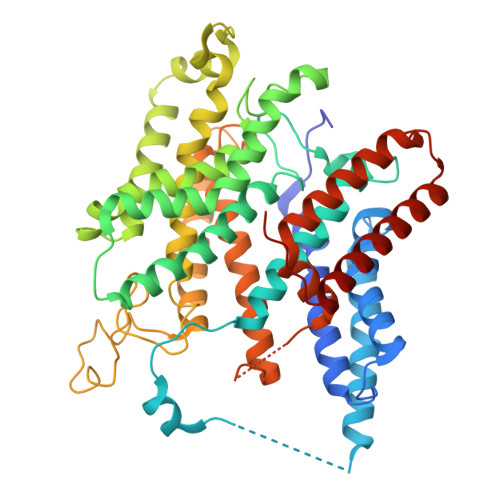
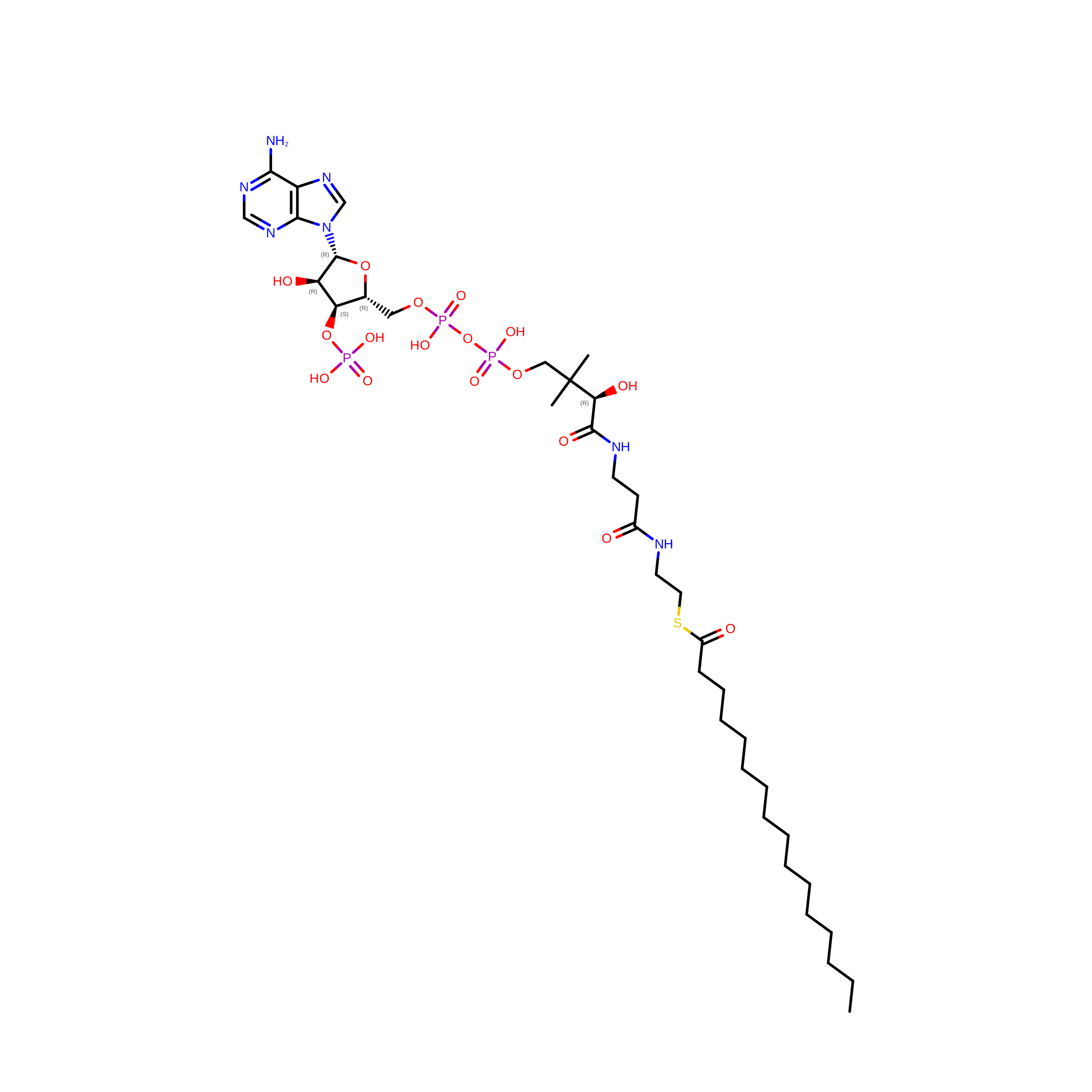
Glycosylphosphatidylinositol (GPI) acyltransferase is crucial for the synthesis of GPI-anchored proteins. Targeting the fungal glycosylphosphatidylinositol acyltransferase GWT1 by manogepix is a promising antifungal strategy. However, the inhibitory mechanism of manogepix remains unclear. Here, we present cryo-EM structures of yeast GWT1 bound to the substrate (palmitoyl-CoA) and inhibitor (manogepix) at 3.3 Å and 3.5 Å, respectively. GWT1 adopts a unique fold with 13 transmembrane (TM) helixes. The palmitoyl-CoA inserts into the chamber among TM4, 5, 6, 7, and 12. The crucial residues (D145 and K155) located on the loop between TM4 and TM5 potentially bind to the GPI precursor, contributing to substrate recognition and catalysis, respectively. The antifungal drug, manogepix, occupies the hydrophobic cavity of the palmitoyl-CoA binding site, suggesting a competitive inhibitory mechanism. Structural analysis of resistance mutations elucidates the drug specificity and selectivity. These findings pave the way for the development of potent and selective antifungal drugs targeting GWT1.
- Department of Obstetrics, Key Laboratory of Birth Defects and Related Disease of Women and Children of MOE, State Key Laboratory of Biotherapy, West China Second Hospital, Sichuan University, Chengdu, China.
Organizational Affiliation: