Download Mendeley
Structure of human glycoprotein 2 reveals mechanisms underlying filament formation and adaption to proteolytic environment in the digestive tract.
Han, J., Song, M., Cheng, Y., Gong, W., Zhang, F., Cao, Q.(2025) PLoS Biol 23: e3003238-e3003238
- PubMed: 40550004 Search on PubMedSearch on PubMed Central
- DOI: https://doi.org/10.1371/journal.pbio.3003238
- Primary Citation Related Structures:
8XC5 - PubMed Abstract:
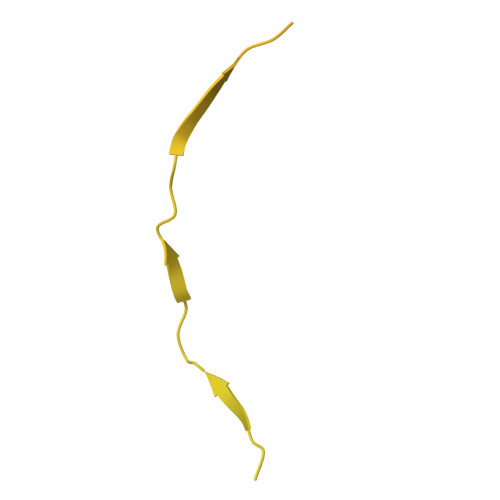
Glycoprotein 2 (GP2) and Uromodulin (UMOD) are considered as paralogs that share high sequence similarity and have similar antibacterial functions. UMOD are abundant as filaments in the urinary tract, and a high-mannose N-glycosylation site located on the N-terminal region protruding from UMOD filament core (referred to as branch) acts as an adhesion antagonist against pathogenic bacterial infections. The antibacterial function of UMOD can be eliminated by proteases, as the UMOD branch is susceptible to proteolytic activity. GP2 is expressed in the pancreas and secreted into the digestive tract. Whether GP2 executes its function in filament form and how it remains functional in the protease-enriched digestive tract is unclear. In this study, we extract GP2 filaments from surgically excised human pancreas and determined their cryo-EM structure. Our structure analysis unveiled that GP2 forms filaments with its ZP modules, composing the ZPN and ZPC domains along with a linker that connects these two domains. The N-terminal region (branch) of GP2 does not constitute the filament core and appears flexible in the cryo-EM structure. Our biochemical experiments suggested that although the GP2 branch is also protease-susceptible, additional high-mannose N-glycans were identified on the protease-resistant GP2 filament core. Consequently, the branch-free GP2 filaments retain their binding ability to the bacterial adhesin FimH, ensuring GP2's antibacterial function unaffected in the proteolytic environment. Our study provides the first experimental evidence of GP2 filament formation and reveals the molecular mechanisms underlying GP2's adaptation to a different environment compared to UMOD.
- Bio-X Institutes, Key Laboratory for the Genetics of Developmental and Neuropsychiatric Disorders, Ministry of Education, Shanghai Jiao Tong University, Shanghai, China.
Organizational Affiliation: