Download Mendeley
Efficient production of protocatechuic acid using systems engineering of Escherichia coli.
Wang, M., Wang, H., Gao, C., Wei, W., Liu, J., Chen, X., Hu, G., Song, W., Wu, J., Zhang, F., Liu, L.(2024) Metab Eng 82: 134-146
- PubMed: 38369051 Search on PubMed
- DOI: https://doi.org/10.1016/j.ymben.2024.02.003
- Primary Citation Related Structures:
8WM1 - PubMed Abstract:
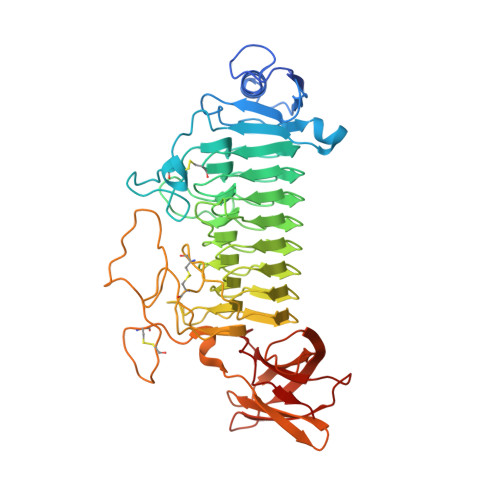
Protocatechuic acid (3, 4-dihydroxybenzoic acid, PCA) is widely used in the pharmaceuticals, health food, and cosmetics industries owing to its diverse biological activities. However, the inhibition of 3-dehydroshikimate dehydratase (AroZ) by PCA and its toxicity to cells limit the efficient production of PCA in Escherichia coli. In this study, a high-level strain of 3-dehydroshikimate, E. coli DHS01, was developed by blocking the carbon flow from the shikimate-overproducing strain E. coli SA09. Additionally, the PCA biosynthetic pathway was established in DHS01 by introducing the high-activity ApAroZ. Subsequently, the protein structure and catalytic mechanism of 3-dehydroshikimate dehydratase from Acinetobacter pittii PHEA-2 (ApAroZ) were clarified. The variant ApAroZ R363A , achieved by modulating the conformational dynamics of ApAroZ, effectively relieved product inhibition. Additionally, the tolerance of the strain E. coli PCA04 to PCA was enhanced by adaptive laboratory evolution, and a biosensor-assisted high-throughput screening method was designed and implemented to expedite the identification of high-performance PCA-producing strains. Finally, in a 5 L bioreactor, the final strain PCA05 achieved the highest PCA titer of 46.65 g/L, a yield of 0.23 g/g, and a productivity of 1.46 g/L/h for PCA synthesis from glucose using normal fed-batch fermentation. The strategies described herein serve as valuable guidelines for the production of other high-value and toxic products.
- School of Biotechnology and Key Laboratory of Industrial Biotechnology of Ministry of Education, Jiangnan University, Wuxi, 214122, China.
Organizational Affiliation: