Download Mendeley
De Novo Discovery of Cysteine Frameworks for Developing Multicyclic Peptide Libraries for Ligand Discovery.
Li, J., Liu, H., Xiao, S., Fan, S., Cheng, X., Wu, C.(2023) J Am Chem Soc 145: 28264-28275
- PubMed: 38092662 Search on PubMed
- DOI: https://doi.org/10.1021/jacs.3c11856
- Primary Citation Related Structures:
8WGI, 8WGJ - PubMed Abstract:
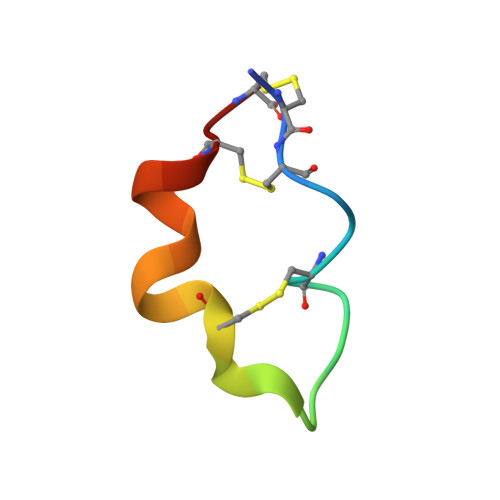
Conserved cysteine frameworks are essential components of disulfide-rich peptides (DRPs), which dominantly define the structural diversity of both naturally occurring and de novo-designed DRPs. However, there are only very limited numbers of conserved cysteine frameworks, and general methods enabling de novo discovery of cysteine frameworks with robust foldability are still not available. Here, we devised a "touchstone"-based strategy that relies on chasing oxidative foldability between two individual disulfide-rich folds on the phage surface to discover new cysteine frameworks from random sequences. Unique cysteine frameworks with a high degree of compatibility with phage display systems and broad sequence tolerance were successfully identified, which were subsequently exploited for the development of multicyclic DRP libraries, enabling the rapid discovery of new peptide ligands with low-nanomolar and picomolar binding affinity. This study provides an unprecedented method for exploring and exploiting the sequence and structure space of DRPs that is not readily accessible by existing strategies, holding the potential to revolutionize the study of DRPs and significantly advance the design and discovery of multicyclic peptide ligands and drugs.
- The MOE Key Laboratory of Spectrochemical Analysis and Instrumentation, State Key Laboratory of Physical Chemistry of Solid Surfaces, Department of Chemistry, College of Chemistry and Chemical Engineering, Xiamen University, Xiamen 361005, P. R. China.
Organizational Affiliation: