Download Mendeley
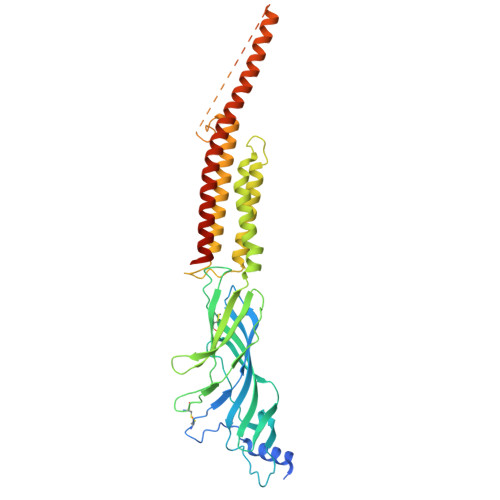
Cryo-EM structure of the zinc-activated channel (ZAC) in the Cys-loop receptor superfamily.
Jin, F., Lin, Y.Y., Wang, R.C., Xie, T.X., Zhao, Y., Shen, C., Sheng, D., Ichikawa, M., Yu, Y., Wang, J., Hattori, M.(2024) Proc Natl Acad Sci U S A 121: e2405659121-e2405659121
- PubMed: 39441630 Search on PubMedSearch on PubMed Central
- DOI: https://doi.org/10.1073/pnas.2405659121
- Primary Citation Related Structures:
8WGE, 8ZTS - PubMed Abstract:
Cys-loop receptors are a large superfamily of pentameric ligand-gated ion channels with various physiological roles, especially in neurotransmission in the central nervous system. Among them, zinc-activated channel (ZAC) is a Zn 2+ -activated ion channel that is widely expressed in the human body and is conserved among eukaryotes. Due to its gating by extracellular Zn 2+ , ZAC has been considered a Zn 2+ sensor, but it has undergone minimal structural and functional characterization since its molecular cloning. Among the families in the Cys-loop receptor superfamily, only the structure of ZAC has yet to be determined. Here, we determined the cryo-EM structure of ZAC in the apo state and performed structure-based mutation analyses. We identified a few residues in the extracellular domain whose mutations had a mild impact on Zn 2+ sensitivity. The constriction site in the ion-conducting pore differs from the one in other Cys-loop receptor structures, and further mutational analysis identified a key residue that is important for ion selectivity. In summary, our work provides a structural framework for understanding the ion-conducting mechanism of ZAC.
- State Key Laboratory of Genetic Engineering, Shanghai Key Laboratory of Bioactive Small Molecules, Collaborative Innovation Center of Genetics and Development, Department of Physiology and Neurobiology, School of Life Sciences, Fudan University, Shanghai 200438, China.
Organizational Affiliation: