Download Mendeley
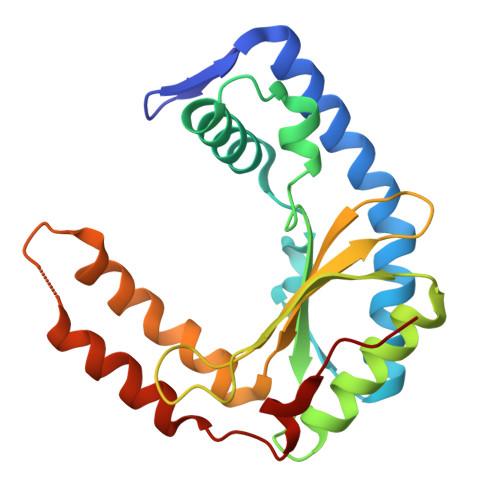
Bacteria export alarmone synthetases that produce (p)ppApp and (p)ppGpp.
Ahmad, S., Guedez, A.G., Manisa, B., Adewale, A., Tsang, K.K., Schiefer, V., Bullen, N.P., Thakar, H., Kim, Y., Wang, B., Whitney, J.C.(2025) mBio 16: e0222725-e0222725
- PubMed: 41222238 Search on PubMedSearch on PubMed Central
- DOI: https://doi.org/10.1128/mbio.02227-25
- Primary Citation Related Structures:
8VX3 - PubMed Abstract:
Guanosine penta- and tetraphosphate [(p)ppGpp] and their adenosine analogs [(p)ppApp] are bacterial second messengers known as alarmones. Members of the RelA-SpoT homolog (RSH) family synthesize (p)ppGpp to mediate the stringent response during nutrient starvation, whereas (p)ppApp synthetases have been identified as bactericidal toxins in diverse contexts including type VI secretion systems, toxin-antitoxin modules, and phages. Although alarmone synthesis has traditionally been viewed as a cytoplasmic process, early studies in Streptomyces suggested the existence of secreted alarmone synthetases. Here, we identify Sa EAS, an e xported a larmone s ynthetase (EAS) from Streptomyces albidoflavus , as the long-mysterious source of extracellular alarmone synthetase activity in Streptomyces. Sa EAS produces both (p)ppGpp and (p)ppApp at rates exceeding 100,000 molecules per minute and has kinetic properties adapted to low substrate environments. A broader bioinformatic survey reveals ~600 EASs linked to a range of specialized bacterial secretion systems. Characterization of two additional EASs, Vp EAS from Vibrio parahaemolyticus and Aa EAS from Amycolatopsis azurea , shows that both produce (p)ppGpp exclusively and inhibit bacterial growth when localized to the cytoplasm. These findings challenge the longstanding view of (p)ppGpp as strictly pro-survival and unveil a diverse family of secreted RSH enzymes with potential roles in interbacterial antagonism and environmental signaling.IMPORTANCEAlarmone synthetases are intracellular enzymes that promote bacterial survival by responding to environmental stress. Although extracellular alarmone production has been reported in Streptomyces , the enzymes responsible for this activity remain unknown. Here, we identify hundreds of predicted exported alarmone synthetases (EASs) associated with bacterial protein export pathways. We show that Sa EAS, secreted by Streptomyces albidoflavus , efficiently synthesizes (p)ppGpp and (p)ppApp in low substrate extracellular environments. When localized to the cytoplasm, Sa EAS and two (p)ppGpp-specific EASs from Vibrio parahaemolyticus and Amycolatopsis azurea rapidly inhibit cell growth. Overall, our findings show that (p)ppGpp is not always a bacteriostatic, pro-survival molecule and suggest that the physiological consequences of alarmone production depend more on context and enzyme kinetics than on alarmone identity.
- Temerty Faculty of Medicine, University of Toronto, Toronto, Ontario, Canada.
Organizational Affiliation: