Download Mendeley
Structural elucidation of a unique binding mode by an intact alphavirus human IgG molecule to a quaternary epitope.
Bandyopadhyay, A., Williamson, L.E., Sirohi, D., Bailey, K., Gilliland Jr., T., Klose, T., Buda, G., Trivette, A., Sun, C., Julander, J.G., Klimstra, W.B., Crowe Jr., J.E., Kuhn, R.J.(2025) Nat Commun 16: 7716-7716
- PubMed: 40830099 Search on PubMedSearch on PubMed Central
- DOI: https://doi.org/10.1038/s41467-025-60505-x
- Primary Citation Related Structures:
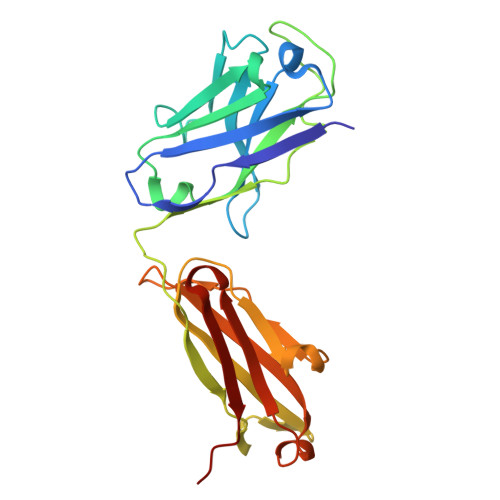
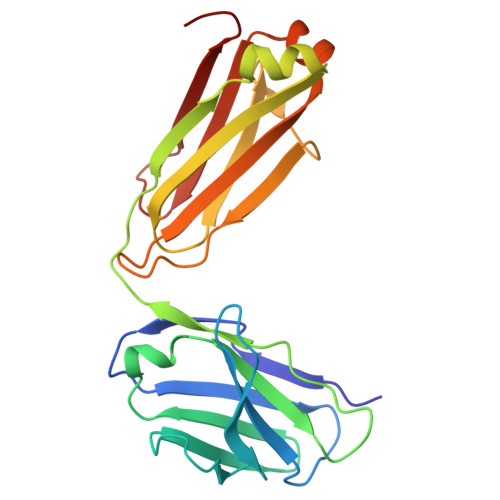
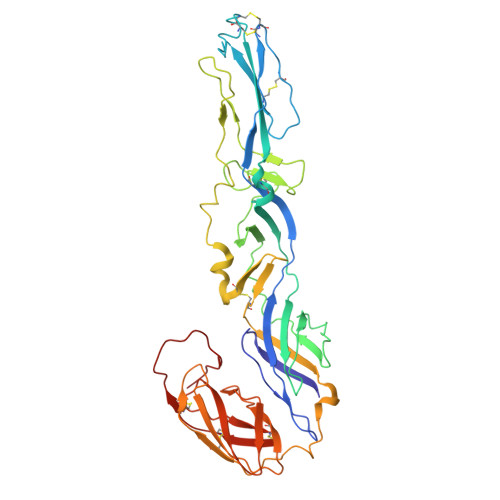
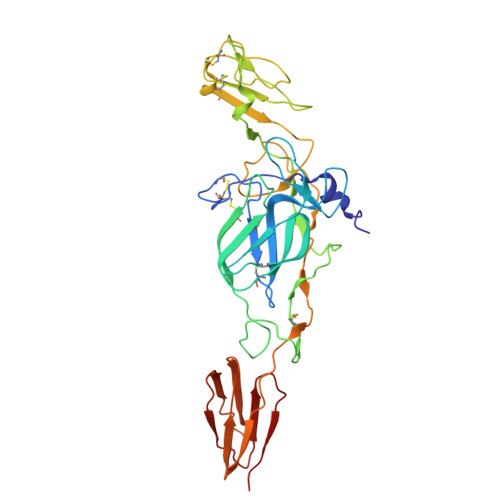
8VSV, 9AY1 - PubMed Abstract:
Eastern equine encephalitis virus (EEEV) is a mosquito-transmitted alphavirus that can cause severe encephalitis in humans and horses with a high case fatality rate. There are no licensed EEEV vaccines or therapeutics for human use, warranting the need to better understand the human immune response against EEEV. Here we present a cryo-EM reconstruction of the chimeric virus, Sindbis (SINV)/EEEV, in complex with a potently neutralizing and efficacious intact human IgG1 antibody in a mouse model of infection and disease. This antibody requires bivalency to recognize a quaternary epitope on the E2 glycoprotein and cross-links two virus spikes across the icosahedral two-fold axis through a unique binding mode. Kinetic analysis of the binding interaction provides insights into this distinguishing feature. Mechanistically, the antibody inhibits viral entry into cells through blockade of receptor binding and early fusion events but does not block egress, thereby, exclusively targeting an epitope found on intact virions. The discovery of the quaternary epitope and unique binding mode recognized by this antibody together advance our understanding of the complexity of antibody-antigen interactions and can aid in vaccine design to elicit recognition of distinct epitopes of clinically relevant alphaviruses.
- Department of Biological Sciences, Purdue University, West Lafayette, IN, 47907, USA.
Organizational Affiliation: